
The eBooks we sell are sold as a single-user licence and are intended for the end user only.
The sale of some eBooks are restricted to certain countries. To alert you to such restrictions, please select the country of the billing address of your credit or debit card you wish to use for payment.
For further information see https://www.wildy.com/ebook-formats
Once the order is confirmed an e-mail will be sent to you to allow you to download the eBook. For UK purchases this will be automatic. For purchases outside the UK a member of staff will need to confirm the sale. (Staff are available to do this during normal business hours, Mon-Fri 8:30-17:00 UK time)
All eBooks are supplied firm sale and cannot be returned. If you believe there is a fault with your eBook then contact us on ebooks@wildy.com and we will help in resolving the issue. This does not affect your statutory rights.
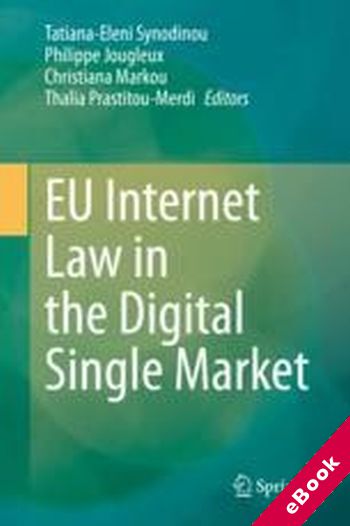
With the ongoing evolution of the digital society challenging the boundaries of the law, new questions are arising - and new answers being given - even now, almost three decades on from the digital revolution. Written by a panel of legal specialists and edited by experts on EU Internet law, this book provides an overview of the most recent developments affecting the European Internet legal framework, specifically focusing on four current debates. Firstly, it discusses the changes in online copyright law, especially after the enactment of the new directive on the single digital market. Secondly, it analyzes the increasing significance of artificial intelligence in our daily life. The book then addresses emerging issues in EU digital law, exploring out of the box approaches in Internet law. It also presents the last cyber-criminality law trends (offenses, international instrument, behaviors), and discusses the evolution of personal data protection. Lastly, it evaluates the degree of consumer and corporate protection in the digital environment, demonstrating that now, more than ever, EU Internet law is based on a combination of copyright, civil, administrative, criminal, commercial and banking laws.










