
The eBooks we sell are sold as a single-user licence and are intended for the end user only.
The sale of some eBooks are restricted to certain countries. To alert you to such restrictions, please select the country of the billing address of your credit or debit card you wish to use for payment.
For further information see https://www.wildy.com/ebook-formats
Once the order is confirmed an e-mail will be sent to you to allow you to download the eBook. For UK purchases this will be automatic. For purchases outside the UK a member of staff will need to confirm the sale. (Staff are available to do this during normal business hours, Mon-Fri 8:30-17:00 UK time)
All eBooks are supplied firm sale and cannot be returned. If you believe there is a fault with your eBook then contact us on ebooks@wildy.com and we will help in resolving the issue. This does not affect your statutory rights.
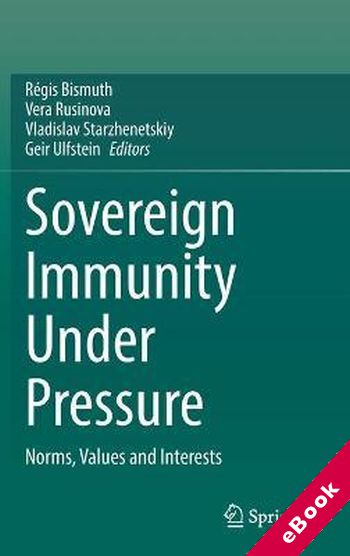
This book offers a critical analysis of current challenges and developments of the State immunity regime through three dimensions: it looks at State immunity from a comparative perspective; it discusses the major trends relating to the interplay between State immunity and the protection of human rights as well as counter-terrorism; and it examines the relationship between State immunity and the financial obligations of States.
Part I, Sovereign Immunity from a Comparative Perspective: Weak v. Strong Immunity Regimes, deals with the diversity of existing regimes of State immunity at the national level. This part aims to explore different approaches of particular states to sovereign immunity and their general attitude to international law, and attempts to understand why some States favour a weaker State immunity regime by multiplying exceptions or interpreting them broadly, while others continuously support a stronger one and sometimes rely on the doctrine of absolute immunity.
Part II, International Customary Law of Sovereign Immunity, Human Rights and Counter-Terrorism, highlights how human rights and counter-terrorism have shaped the law and practice of sovereign immunity. This part specifically discusses the role of national legislators and judges in the development of international law, emerging conflicts between national constitutional norms and the rules of international law concerning State immunity and human rights, and possible ways of their reconciliation.
Part III, Sovereign Immunity of States and their Financial Obligations, contributes to on-going debates related to the mixed and complex nature of States' financial obligations. In this part, authors elaborate on perceptions of the underlying public-private law divide, cross influences in public and private international law and their consequences for State immunity, as well as recent trends relating to immunity from execution.











