The eBooks we sell are sold as a single-user licence and are intended for the end user only.
The sale of some eBooks are restricted to certain countries. To alert you to such restrictions, please select the country of the billing address of your credit or debit card you wish to use for payment.
For further information see https://www.wildy.com/ebook-formats
Once the order is confirmed an e-mail will be sent to you to allow you to download the eBook. For UK purchases this will be automatic. For purchases outside the UK a member of staff will need to confirm the sale. (Staff are available to do this during normal business hours, Mon-Fri 8:30-17:00 UK time)
All eBooks are supplied firm sale and cannot be returned. If you believe there is a fault with your eBook then contact us on ebooks@wildy.com and we will help in resolving the issue. This does not affect your statutory rights.
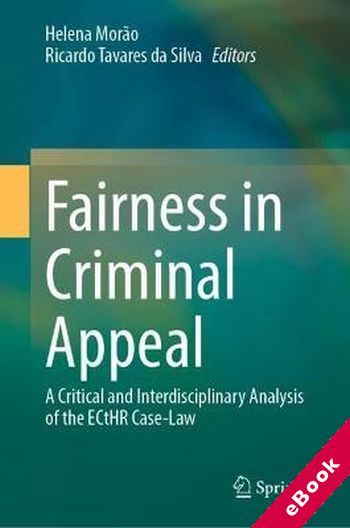
This book addresses the European Court of Human Rights' fairness standards in criminal appeal, filling a gap in this less researched area of studies. Based on a fair trial immediacy requirement, the Court has found several violations of Article 6 of the European Convention on Human Rights at the appellate level by at least eighteen States of the Council of Europe in a vast array of cases, particularly in contexts of first instance acquittals overturning and of sentences increasing on appeal.
On the one hand, the book critically engages this case-law with the law revisions it has recently inspired in European countries, as well as with the critiques and difficulties that it continues to raise. On the other hand, it interweaves insight from criminal procedure theory with new discoveries in the field of cognitive sciences (neuroscience of memory, philosophy of knowledge, AI), shedding an interdisciplinary light on the (in)adequacy and limits of the Strasbourg Court's jurisprudence.