
The eBooks we sell are sold as a single-user licence and are intended for the end user only.
The sale of some eBooks are restricted to certain countries. To alert you to such restrictions, please select the country of the billing address of your credit or debit card you wish to use for payment.
For further information see https://www.wildy.com/ebook-formats
Once the order is confirmed an e-mail will be sent to you to allow you to download the eBook. For UK purchases this will be automatic. For purchases outside the UK a member of staff will need to confirm the sale. (Staff are available to do this during normal business hours, Mon-Fri 8:30-17:00 UK time)
All eBooks are supplied firm sale and cannot be returned. If you believe there is a fault with your eBook then contact us on ebooks@wildy.com and we will help in resolving the issue. This does not affect your statutory rights.
Male-dominated law and legal knowledge essentially characterized the whole of pre-modern history in that the patriarchy represented the axis of social relations in both the private and public spheres. Indeed, modern and even contemporary law still have embedded elements of patriarchal heritage, even in the secular modern legal systems of Western developed countries, either within the content of legislation or in terms of its implementation and interpretation. This is true to a greater or lesser extent across legal systems, although the secular modern legal systems of the Western developed countries have made great advances in terms of gender equality. The traditional understanding of law has always been self-evidently dominated by men, but modern law and its understanding have also been more or less "malestreamed." Therefore, it has become necessary to overcome the given "maskulinity" of legal thought.
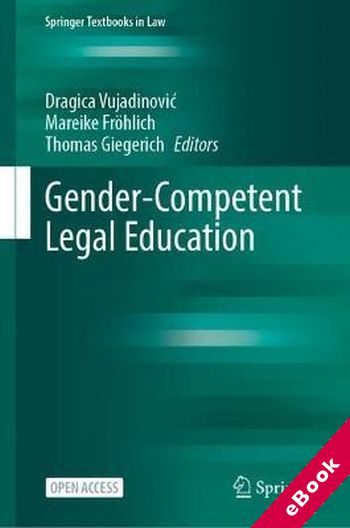
In contemporary legal and political orders, gender mainstreaming of law has been of the utmost importance for overcoming deeply and persistently embedded power relations and gender-based, unequal social relations. At the same time and equally importantly, the gender mainstreaming of legal education - to which this book aims to contribute - can help to gradually eliminate this male dominance and accompanying power relations from legal education and higher education as a whole.










