
The eBooks we sell are sold as a single-user licence and are intended for the end user only.
The sale of some eBooks are restricted to certain countries. To alert you to such restrictions, please select the country of the billing address of your credit or debit card you wish to use for payment.
For further information see https://www.wildy.com/ebook-formats
Once the order is confirmed an e-mail will be sent to you to allow you to download the eBook. For UK purchases this will be automatic. For purchases outside the UK a member of staff will need to confirm the sale. (Staff are available to do this during normal business hours, Mon-Fri 8:30-17:00 UK time)
All eBooks are supplied firm sale and cannot be returned. If you believe there is a fault with your eBook then contact us on ebooks@wildy.com and we will help in resolving the issue. This does not affect your statutory rights.
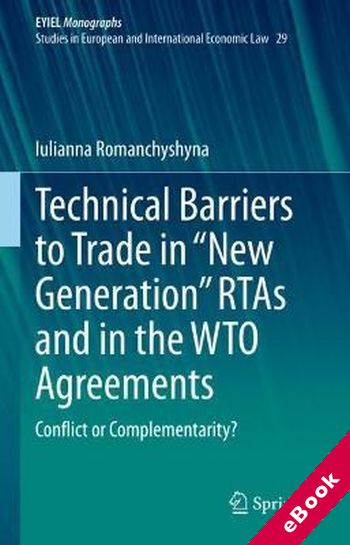
This book examines the interplay between cooperation on technical barriers to trade (TBT) in free trade agreements and the multilateral framework of the World Trade Organization. In recent years, TBT, especially differences in standards, have attracted increased interest and have been addressed as part of the WTO+ negotiated agenda in trade agreements. Because of a number of political and legal constraints, the process of further cooperation at the WTO have been stalled, which made free trade agreements a central pillar in setting the agenda of international trade governance. This leads us to rethinking the interrelation between the WTO and free trade agreements and to questioning the role of both fora in the future of trade.
The book examines some TBT provisions in free trade agreements and highlights their positive and problematic aspects when it comes to the WTO-consistency and the ideas of open and inclusive trade. It also suggests that a more optimal way forward would be to increase parallel work on TBT cooperation at the WTO, a more inclusive forum that could address issues of global significance, such as environmental protection and regulation of digital goods. The book explores the potential for trade agreements to advance the WTO agenda, but notes that the organization would need to adapt its institutional structure and governance in order to do so.
Drawing on the example of the EU and US so-called "new generation" trade agreements, the book provides a detailed analysis of the various methods used to navigate TBT cooperation, and offers insight into how these agreements can serve as inspiration for future multilateral disciplines.
This book is a valuable resource for trade law academics, policymakers, and anyone interested in the intersection of technical barriers to trade, regional trade agreements, and the WTO.











