
The eBooks we sell are sold as a single-user licence and are intended for the end user only.
The sale of some eBooks are restricted to certain countries. To alert you to such restrictions, please select the country of the billing address of your credit or debit card you wish to use for payment.
For further information see https://www.wildy.com/ebook-formats
Once the order is confirmed an e-mail will be sent to you to allow you to download the eBook. For UK purchases this will be automatic. For purchases outside the UK a member of staff will need to confirm the sale. (Staff are available to do this during normal business hours, Mon-Fri 8:30-17:00 UK time)
All eBooks are supplied firm sale and cannot be returned. If you believe there is a fault with your eBook then contact us on ebooks@wildy.com and we will help in resolving the issue. This does not affect your statutory rights.
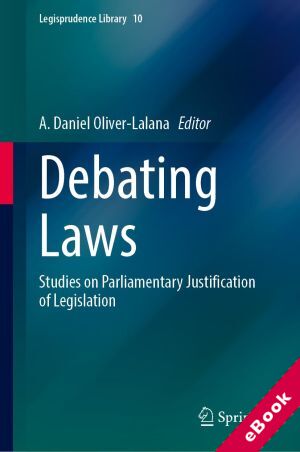
This book seeks to explore the potential and actual value of parliamentary debates as a source of legislative justification. Drawing on a sample of recent Spanish legislation, the papers collected here analyse (critically) the rationale of several laws or legislative measures as it can be reconstructed from the respective parliamentary discussions. All issues covered have given rise to intense political, legal and social controversy: they range from the combat against gender violence, the legal status of bullfighting, the protection of crime victims and the so-called ‘push-backs’ at the border, to the regulation of euthanasia, the minimum living income, underage girls’ access to abortion, and joint child custody. The volume is organised into two main parts. The first group of case studies adopt a legisprudential perspective and examine parliamentary deliberations in the light of the theory and methodology of legislative justification; the contributions in the second part follow approaches that fall outside – but are largely compatible with –legisprudence, and deal with aspects such as the rhetorical strategies employed by MPs when debating bills, and the role of elected legislators as constitutional interpreters.










