
The eBooks we sell are sold as a single-user licence and are intended for the end user only.
The sale of some eBooks are restricted to certain countries. To alert you to such restrictions, please select the country of the billing address of your credit or debit card you wish to use for payment.
For further information see https://www.wildy.com/ebook-formats
Once the order is confirmed an e-mail will be sent to you to allow you to download the eBook. For UK purchases this will be automatic. For purchases outside the UK a member of staff will need to confirm the sale. (Staff are available to do this during normal business hours, Mon-Fri 8:30-17:00 UK time)
All eBooks are supplied firm sale and cannot be returned. If you believe there is a fault with your eBook then contact us on ebooks@wildy.com and we will help in resolving the issue. This does not affect your statutory rights.
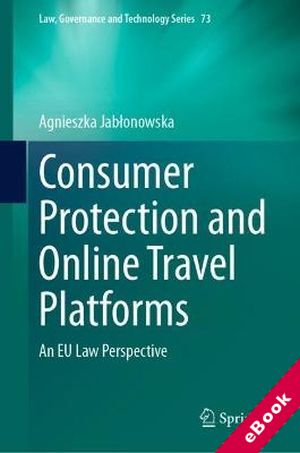
Online platforms have transformed the travel sector by enhancing the availability of travel services and lowering transaction costs; however, they have also posed new challenges for consumer protection. The book studies this transformation, assesses the relevant EU acquis, and explores how the legal framework could be improved to better protect consumer interests in a platform-driven market.
The book examines the private governance mechanisms employed by leading platform operators and identifies their strengths and weaknesses. Building upon these insights, it then delves into the EU legal framework, including the Digital Services Act and the Package Travel Directive. It identifies gaps in the protection of consumers concluding contracts through online travel platforms and proposes strategies for addressing these gaps through horizontal and sectoral rules. In this context, the book reflects on key notions of consumer law such as information, safety and performance, as well as the associated role of platform providers.
Focusing on stand-alone contracts for individual travel services, this study offers new perspectives on consumer protection, the digital economy, and EU law. It will appeal to both legal researchers and practitioners seeking to navigate digital markets and the complexities of their regulation. By showing how EU law can better protect consumers in connection with online travel platforms, the book offers a valuable resource for legal interpretation and future policy evolution.











