
The eBooks we sell are sold as a single-user licence and are intended for the end user only.
The sale of some eBooks are restricted to certain countries. To alert you to such restrictions, please select the country of the billing address of your credit or debit card you wish to use for payment.
For further information see https://www.wildy.com/ebook-formats
Once the order is confirmed an e-mail will be sent to you to allow you to download the eBook. For UK purchases this will be automatic. For purchases outside the UK a member of staff will need to confirm the sale. (Staff are available to do this during normal business hours, Mon-Fri 8:30-17:00 UK time)
All eBooks are supplied firm sale and cannot be returned. If you believe there is a fault with your eBook then contact us on ebooks@wildy.com and we will help in resolving the issue. This does not affect your statutory rights.
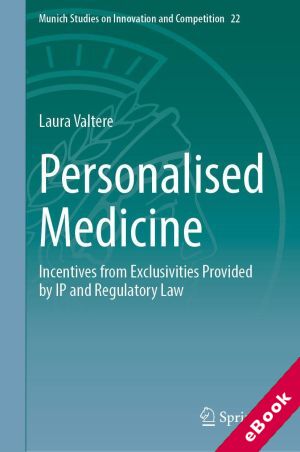
It is commonly held that the limited market of Personalised Medicine (PM) undermines the relevance of patent protection, given the limited returns on investment. However, contrary to initial assumptions, this study finds that PM markets are not per se unattractive financially because of their size. While each application market may be characterised by a smaller consumer base, this does not represent the entire scale of the market. The same substance may be utilised for a multitude of applications, encompassing both personalised and conventional drugs. In addition, factors such as the added value of more efficient and targeted treatments and cost reduction of clinical trials also enhance PM’s appeal.
Despite the absence of any substantial challenges to the patentability of PM drugs and diagnostics in Europe, the enforcement of these rights against infringement is notably challenging. The uncertain enforcement environment has been shown to encourage strategic behavior from both patent holders and generic manufacturers, potentially leading to market dysfunction.
In light of the patent system’s inherent limitations, the study also investigates the regulatory exclusivity framework. This study provides an unprecedented holistic examination of the incentives for PM under patent, supplementary protection certificates, and regulatory laws.
The study’s findings also reveal that while the EU aspires to lead globally in PM research and acknowledge its societal importance—especially given ageing populations and mounting healthcare expenses—no specific exclusivity rights for PM have been introduced or the existing ones adapted. In order to address this gap, the author deconstructs the concept of PM from scientific, economic, and normative perspectives to identify potential subjects that could be covered by exclusivity rights.
The in-depth analysis effectively demystifies the complex scientific and economic foundations of PM, rendering them accessible and comprehensible. By undertaking this analysis, the author identifies areas within PM that may benefit from the de lege lata exclusivities or from the implementation of dedicated exclusivity rights as well as the incoherences in de lege lata and its application, especially in regard to regulatory law.










