
The eBooks we sell are sold as a single-user licence and are intended for the end user only.
The sale of some eBooks are restricted to certain countries. To alert you to such restrictions, please select the country of the billing address of your credit or debit card you wish to use for payment.
For further information see https://www.wildy.com/ebook-formats
Once the order is confirmed an e-mail will be sent to you to allow you to download the eBook. For UK purchases this will be automatic. For purchases outside the UK a member of staff will need to confirm the sale. (Staff are available to do this during normal business hours, Mon-Fri 8:30-17:00 UK time)
All eBooks are supplied firm sale and cannot be returned. If you believe there is a fault with your eBook then contact us on ebooks@wildy.com and we will help in resolving the issue. This does not affect your statutory rights.
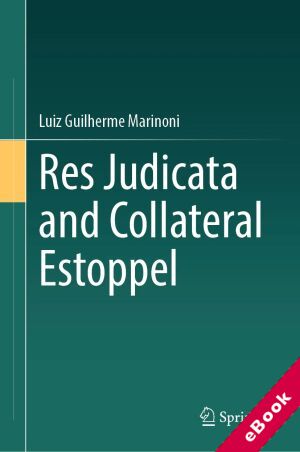
This book offers a comprehensive exploration of the concept of "res judicata" (thing judged) in the context of both common law and civil law systems, with a particular focus on the Brazilian Civil Procedure Code. It delves into the historical evolution, theoretical foundations, and practical implications of issue preclusion, or the prohibition of relitigating decided issues. The work also examines the development of issue preclusion in common law, especially in the United States, discussing key concepts like estoppel, collateral estoppel, and the breakdown of mutuality.
Landmark cases such as Blonder-Tongue and Parklane are analyzed to illustrate the evolution and application of these principles. It contrasts the common law approach with the civil law tradition, particularly the Italian legal system, critiquing the influence of Roman law and the doctrines of prominent jurists like Chiovenda, highlighting the limitations and values underlying the restriction of res judicata to the judgment of the claim.
The author explains the extension of res judicata to issues, including the benefits for third parties, discussing the requirements for issue preclusion, the relationship between issue preclusion and the main claim, and the impact of issue preclusion on arbitration and mandatory precedentes, making this book an essential resource for legal scholars, practitioners, and students interested in understanding the complexities of res judicata across different legal systems and its critical role in ensuring legal certainty, coherence, and efficiency in judicial proceedings.










