
The eBooks we sell are sold as a single-user licence and are intended for the end user only.
The sale of some eBooks are restricted to certain countries. To alert you to such restrictions, please select the country of the billing address of your credit or debit card you wish to use for payment.
For further information see https://www.wildy.com/ebook-formats
Once the order is confirmed an e-mail will be sent to you to allow you to download the eBook. For UK purchases this will be automatic. For purchases outside the UK a member of staff will need to confirm the sale. (Staff are available to do this during normal business hours, Mon-Fri 8:30-17:00 UK time)
All eBooks are supplied firm sale and cannot be returned. If you believe there is a fault with your eBook then contact us on ebooks@wildy.com and we will help in resolving the issue. This does not affect your statutory rights.
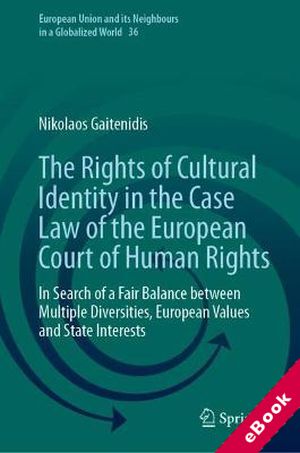
The book explores the links between fundamental rights and cultural identity in the European legal order especially in the case law of the European Court of Human Rights. The book analyses the issues surrounding the relationship between cultural diversity and fundamental rights with special emphasis on cultural rights and their protection in the European legal order. The book addresses general fundamental rights questions such as universality and cultural relativism and the principles of equality and non-discrimination. Secondly, several cases are discussed in which human rights were invoked to protect cultural interests of minorities in the European Court of Human Rights. Individual and collective dimensions of fundamental rights are also taken into consideration. Also, the book explores the cases were human rights are invoked in order to protect individual from cultural practices which are considered harmful or against public order, public morals, public healthor the rights of others.
The book provides a comprehensive overview of the case law of the ECHR on issues related to cultural identity and proposes a human rights framework for the management of cultural diversity in multi-cultural societies based on the case law of the European Court of Human Rights.










