
The eBooks we sell are sold as a single-user licence and are intended for the end user only.
The sale of some eBooks are restricted to certain countries. To alert you to such restrictions, please select the country of the billing address of your credit or debit card you wish to use for payment.
For further information see https://www.wildy.com/ebook-formats
Once the order is confirmed an e-mail will be sent to you to allow you to download the eBook. For UK purchases this will be automatic. For purchases outside the UK a member of staff will need to confirm the sale. (Staff are available to do this during normal business hours, Mon-Fri 8:30-17:00 UK time)
All eBooks are supplied firm sale and cannot be returned. If you believe there is a fault with your eBook then contact us on ebooks@wildy.com and we will help in resolving the issue. This does not affect your statutory rights.
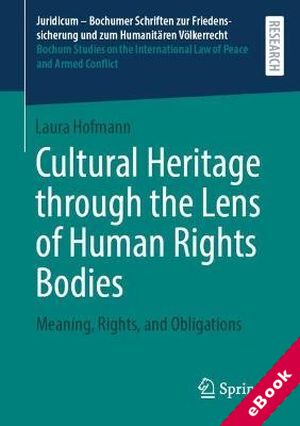
This book asks, if and how international human rights law can offer a legal basis for the protection of cultural heritage. Against the backdrop of the Committee on Economic, Social and Cultural Rights' General Comment No. 21 in 2009 and the 2011 thematic report of the Special Rapporteur in the field of cultural rights on access and enjoyment of cultural heritage, this book examines one possible answer - through international human rights bodies. To this end, the research reviews the pronouncements and work of selected human rights bodies, specifically the Human Rights Council, the Human Rights Committee and the Committee on Economic, Social and Cultural Rights. Organised along the threefold structure of "meaning", "rights", and "obligations", it examines the meaning of cultural heritage, the relevant rights of individuals and persons belonging to minorities and Indigenous peoples, and the corresponding state obligations vis-a-vis cultural heritage. The book further assesses how human rights tools and mechanisms are used to protect rights relating to cultural heritage.










