
The eBooks we sell are sold as a single-user licence and are intended for the end user only.
The sale of some eBooks are restricted to certain countries. To alert you to such restrictions, please select the country of the billing address of your credit or debit card you wish to use for payment.
For further information see https://www.wildy.com/ebook-formats
Once the order is confirmed an e-mail will be sent to you to allow you to download the eBook. For UK purchases this will be automatic. For purchases outside the UK a member of staff will need to confirm the sale. (Staff are available to do this during normal business hours, Mon-Fri 8:30-17:00 UK time)
All eBooks are supplied firm sale and cannot be returned. If you believe there is a fault with your eBook then contact us on ebooks@wildy.com and we will help in resolving the issue. This does not affect your statutory rights.
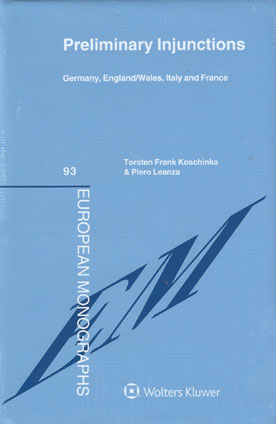
Every legal system, at the outset of court proceedings, has rules aimed at safeguarding parties’ interests during the time needed to obtain a judgment on the merits.
However, as the European Commission put the case in a 1997 communication, ‘a comparative survey of national legislation reveals that there are virtually no definitions of provisional/protective measures and that the legal situations vary widely.
The only convergence that can be ascertained is between the function of such measures.’ Recognizing that after almost twenty years the issues noted by the Commission have not found a satisfactory solution, here at last is a book that collects and compares the ideas behind the ‘preliminary injunction’ (an expression the authors use as a general term for a great variety of provisional and precautionary measures) with an eye to defining and organizing this small but very important aspect of the law.
Although the analysis touches on relevant measures from many countries, the authors focus on the national legislation in four EU Member States – England/Wales, France, Germany, and Italy – to highlight the nature of the differences these kinds of measures entail. They compare and contrast such aspects as the following:-
This incomparable book represents a major contribution to a growing debate, particularly in Europe, on ways and means of securing equivalent protection for all litigants. Given the variety of legal systems and of measures available, the debate will have to focus on the functions served by provisional/protective measures, the minimum conditions to be satisfied, the adversary procedure requirement, the enforceability of the measures, and possible redress procedures.
There is no more thorough and reliable resource available to clarify these issues for practitioners and interested policymakers everywhere.











