The eBooks we sell are sold as a single-user licence and are intended for the end user only.
The sale of some eBooks are restricted to certain countries. To alert you to such restrictions, please select the country of the billing address of your credit or debit card you wish to use for payment.
For further information see https://www.wildy.com/ebook-formats
Once the order is confirmed an e-mail will be sent to you to allow you to download the eBook. For UK purchases this will be automatic. For purchases outside the UK a member of staff will need to confirm the sale. (Staff are available to do this during normal business hours, Mon-Fri 8:30-17:00 UK time)
All eBooks are supplied firm sale and cannot be returned. If you believe there is a fault with your eBook then contact us on ebooks@wildy.com and we will help in resolving the issue. This does not affect your statutory rights.
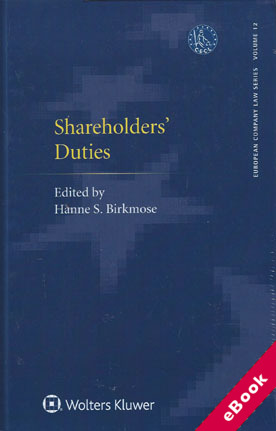
Shareholders’ Duties provides a systematic overview of shareholders’ duties found in European company law and capital market law. It is often assumed that shareholders have rights, not duties.
In recent years, however, this assumption has come under intense scrutiny in all aspects of company law and capital market law – legislation, the courts, soft law, and scholarship. In Europe especially, major changes are under way across a diverse spectrum, all the way from revised contractual arrangements to mandatory statutory provisions.
Such a shift has important implications for the fundamentals of European company law, and there is a need to examine shareholders’ duties and consider where this trend is taking shareholders and their stance in law. This focused collection of essays by twenty notable scholars addresses this complex subject from highly informative and useful variety of perspectives.
What’s in this book.
Examining shareholders’ duties along three axes – types of investee companies, types of shareholders and types of business situations – the essays deal with such topics and issues as the following:-
Examining the implications of this shift in discourse – how shareholders’ duties are coming to the fore under the impetus of legislation, legal doctrine, case law, and enforcement strategies – as well as its ideological underpinnings, this book offers a comprehensive and in-depth consideration of this rapidly developing field. It serves as a handbook for clarifying and focusing investors’ and business leaders’ understanding of the recent corporate governance agenda.
This not only helps policymakers and academics but also investors and practitioners committed in creating conditions favourable to sustainable economic growth and responsible business behaviour.