
The eBooks we sell are sold as a single-user licence and are intended for the end user only.
The sale of some eBooks are restricted to certain countries. To alert you to such restrictions, please select the country of the billing address of your credit or debit card you wish to use for payment.
For further information see https://www.wildy.com/ebook-formats
Once the order is confirmed an e-mail will be sent to you to allow you to download the eBook. For UK purchases this will be automatic. For purchases outside the UK a member of staff will need to confirm the sale. (Staff are available to do this during normal business hours, Mon-Fri 8:30-17:00 UK time)
All eBooks are supplied firm sale and cannot be returned. If you believe there is a fault with your eBook then contact us on ebooks@wildy.com and we will help in resolving the issue. This does not affect your statutory rights.
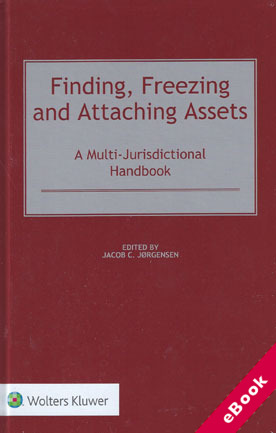
Finding, Freezing and Attaching Assets: A Multi-Jurisdictional Handbook is about how to find out whether a defendant has any assets before initiating costly litigation, arbitration, or insolvency proceedings, and how to freeze such assets with the aim of eventually enforcing a judgment or award.
The globalization in trade relations has resulted in a steady increase in cross-border disputes and, due to the ease with which assets can be moved around the world with the help of online banking and fiduciary service providers, parties are increasingly finding themselves suing or being sued outside their home jurisdictions. As a result, there is increased interest among clients with regard to the finding and freezing of assets as the parties involved in commercial disputes these days are doing their best to expatriate assets as well as undermine enforcement.
The purpose of this book is to provide the reader with as much information as possible on asset identification on a jurisdiction-by-jurisdiction basis and also on the client’s decision of whether or not to freeze assets once the assets have been identified.
The book provides insight on key areas such as:-
Each contribution offers an overview of pre-trial asset tracing techniques and rules regulating freezing orders and enforcement methods in the jurisdiction covered – describing not just what the law says but how the law actually works. The jurisdictions covered include several offshore havens that are frequently used to hide assets in.
As renowned litigator Robert Shapiro says in his Foreword: “The authors provide the reader with practical guidance into the complex area of cross-border asset tracing and do so in a very down-to-earth way, without the academic hyperbole that generally burdens modern legal textbooks.”
This book provides the reader with an overview of the research environment and the sources of information available in different jurisdictions to thereby assist lawyers in finding out whether the other party has assets to pursue. There has been a need for some time for a book of this kind, due to the trend in international litigation and arbitration, and the tendency of parties to hide and remove assets.
The book appeals equally to both litigation and arbitration proceedings and is an indispensable tool for international litigators, arbitration lawyers, and lawyers involved in cross-border insolvency and debt recovery proceedings, as well as for academics and scholars involved in legal research projects or law reform programs.










