
The eBooks we sell are sold as a single-user licence and are intended for the end user only.
The sale of some eBooks are restricted to certain countries. To alert you to such restrictions, please select the country of the billing address of your credit or debit card you wish to use for payment.
For further information see https://www.wildy.com/ebook-formats
Once the order is confirmed an e-mail will be sent to you to allow you to download the eBook. For UK purchases this will be automatic. For purchases outside the UK a member of staff will need to confirm the sale. (Staff are available to do this during normal business hours, Mon-Fri 8:30-17:00 UK time)
All eBooks are supplied firm sale and cannot be returned. If you believe there is a fault with your eBook then contact us on ebooks@wildy.com and we will help in resolving the issue. This does not affect your statutory rights.
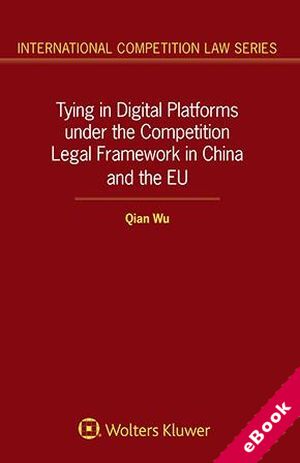
Tying in Digital Platforms under the Competition Legal Framework in China and the EU is an important study providing a comprehensive, systematic, and administrable legal test about how to weigh the dual competitive effects of tying arrangements in digital platforms, showing how two of the world’s largest trading economies—China and the EU—have integrated advantages of the U.S. economics while preserving their own cultural and social characteristics. In today’s digital markets, dominant firms often use tying (the practice of making the purchase of one product conditional on purchasing other products) as a mechanism to extend their dominance. Because the practice could generate both pro-competitive effects and anti-competitive effects, the distinction between lawful and unlawful tying is fraught with legal uncertainties.
What’s in this book:
Through case studies, the book, on the one hand, reveals how economic theories on tying are incorporated into legal frameworks, and, on the other hand, explores the underlying socio-cultural foundations of convergences and divergences between the two jurisdictions. In the course of its investigation, the book elucidates such issues and topics as the following:
How this will help you:
In its comparative law and economics analysis and its concrete guidance on how regulatory frameworks can incorporate economic analysis while navigating the tension with legal certainty, the book distills complex criteria into clear standards that can aid in formulating a context-sensitive framework for refining a competition policy of tying in the digital age. At the same time, the book offers of the social context and cultural reasons behind the emergence and existence of distinct legal rules in China and the EU. Practitioners, policymakers, and academics will gain useful insights for global antitrust dialogue and assess what can be done to foster innovation and pro-competitive tying while regulating anti-competitive tying in digital platforms.











