
The eBooks we sell are sold as a single-user licence and are intended for the end user only.
The sale of some eBooks are restricted to certain countries. To alert you to such restrictions, please select the country of the billing address of your credit or debit card you wish to use for payment.
For further information see https://www.wildy.com/ebook-formats
Once the order is confirmed an e-mail will be sent to you to allow you to download the eBook. For UK purchases this will be automatic. For purchases outside the UK a member of staff will need to confirm the sale. (Staff are available to do this during normal business hours, Mon-Fri 8:30-17:00 UK time)
All eBooks are supplied firm sale and cannot be returned. If you believe there is a fault with your eBook then contact us on ebooks@wildy.com and we will help in resolving the issue. This does not affect your statutory rights.
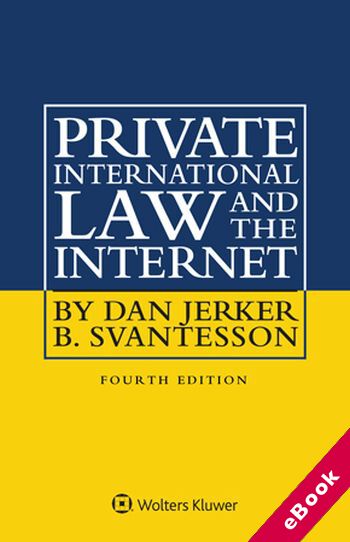
Private International Law and the Internet, in its fourth edition, furnishes an exhaustive and insightful account of what has emerged as the most crucial current issue in private international law; that is, how the Internet affects and is affected by the five fundamental questions: When should a lawsuit be entertained by the courts? Which state’s law should be applied? When should a court that can entertain a lawsuit decline to do so? How wide ‘scope of jurisdiction’ should be afforded to a court with jurisdiction over a dispute? And will a judgment rendered in one country be recognized and enforced in another?
Professor Dan Svantesson identifies and investigates twelve characteristics of Internet communication relevant to these questions and then proceeds with an in-depth discussion of what is required of modern private international law rules.
What’s in this book:
The focus is on several issues that have far-reaching practical consequences in the Internet context, including the following:
A comprehensive survey of private international law solutions encompasses insightful and timely analyses of relevant laws adopted in various jurisdictions, including Australia, England, Hong Kong SAR, the United States, Germany, Sweden, and China, as well as in a range of international instruments. There is also a chapter on advances in geo-identification technologies and their exceptional value for legal practice. The book concludes with two model international conventions, one on cross-border defamation and one on cross-border contracts, as well as a set of practical checklists to guide legal practitioners faced with cross-border matters within the discussed fields.
How this will help you:
This book collates a wealth of research findings in the overlapping disciplines of law and technology that will be of particular utility to practitioners and academics working in this complex and rapidly changing field. The author’s thoughtful analysis of the interplay of the developing Internet and private international law will also prove to be invaluable, as will the tools he offers to anticipate the future. Private International Law and the Internet provides an extraordinary stimulus to continue working towards globally acceptable private international law rules for communication via the Internet.











