
The eBooks we sell are sold as a single-user licence and are intended for the end user only.
The sale of some eBooks are restricted to certain countries. To alert you to such restrictions, please select the country of the billing address of your credit or debit card you wish to use for payment.
For further information see https://www.wildy.com/ebook-formats
Once the order is confirmed an e-mail will be sent to you to allow you to download the eBook. For UK purchases this will be automatic. For purchases outside the UK a member of staff will need to confirm the sale. (Staff are available to do this during normal business hours, Mon-Fri 8:30-17:00 UK time)
All eBooks are supplied firm sale and cannot be returned. If you believe there is a fault with your eBook then contact us on ebooks@wildy.com and we will help in resolving the issue. This does not affect your statutory rights.
In March 2018, the Court of Justice of the European Union (EU) ruled in Achmea that investor-state dispute resolution provisions in intra-EU bilateral investment treaties (BITs) are incompatible with EU law and ipso facto invalid. In January 2019, EU Member States issued Declarations on the Legal Consequences of the Judgment in Achmea undertaking to take steps formally to terminate intra-EU BITs. However, at present, there is no consensus among them on the implications of Achmea on the Energy Charter Treaty, the multilateral energy treaty to which the EU and its Member States are all parties.
Many EU law scholars consider the Achmea judgment as the death knell to intra-EU investment treaty arbitrations. Some have even predicted the end of Investor-State Dispute Settlement itself. Investment treaty and public international law scholars and legal practitioners, however, have a different view of the schism now growing between EU and international law.
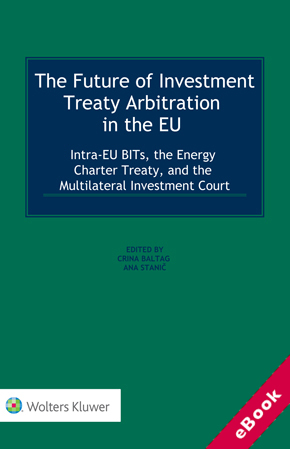
The Future of Investment Treaty Arbitration in the EU examines the current and the proposed new framework for investment protection in the EU and internationally, with a particular focus on investment treaty arbitration and energy-related investments.
With contributions from leading academics and practitioners, the book addresses the following themes:
This eminently informative book is very timely given the ongoing debate taking place in the EU and internationally regarding the interrelationship between investment treaty arbitration, public international law and EU law. The contributions from leading academics, scholars and European Commission officials provide a balanced, contextualized, detailed and critical analysis that will aid interested stakeholders to navigate their way with confidence through this difficult and changing area of the law.










