
Wildy Logo
(020) 7242 5778
enquiries@wildy.com

Book of the Month

Cover of Toulson & Phipps on Confidentiality

Toulson & Phipps on Confidentiality

Price: £175.00

Advocacy: A Practical
Guide 2nd ed


 Peter Lyons, Chris Taylor


Welcome to Wildys

Watch


Judicial Cooperation in Commercial Litigation 3rd ed (The British Cross-Border Financial Centre World)


 Ian Kawaley, David Doyle, Shade Subair Williams


Offers for Newly Called Barristers & Students

Special Discounts for Newly Called & Students

Read More ...


Secondhand & Out of Print

Browse Secondhand Online

Read More...


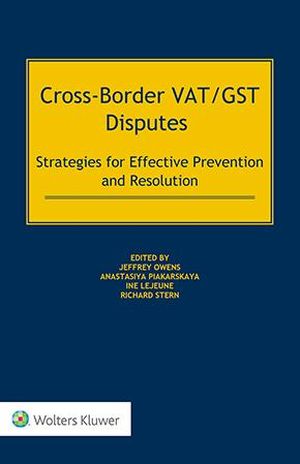
Cross-border VAT/GST Disputes: Strategies for Effective Prevention and Resolution


ISBN13: 9789403516066
To be Published: May 2026
Publisher: Kluwer Law International
Country of Publication: Netherlands
Format: Hardback
Price: £173.00


Cross-Border VAT/GST Disputes: Strategies for Effective Prevention and Resolution is a book that examines recent and ongoing cross-border VAT/GST disputes in both EU and non-EU countries, investigates the causes of these disputes, analyzes the dispute mitigation opportunities provided by existing mechanisms, and explores the potential for leveraging new mechanisms. The distinguished contributors to this volume address these challenges by, for the first time, developing a set of practical, cost-effective policy options in the area of cross-border VAT/GST dispute prevention and resolution.

What’s in this book:

This work offers a structured and practical toolbox for tax policymakers, tax administrations, dispute resolution bodies and businesses. Inspired by the OECD and the EU work and drawing on the experiences of EU and non-EU countries, it outlines actionable strategies to strengthen cross-border VAT/GST dispute prevention and resolution. The authors examine the following topics:

  • a globally more consistent implementation and application of the internationally agreed principles and VAT/GST recommendations developed by the OECD
  • the enhancement of administrative practices at the domestic level to prevent cross-border VAT/GST disputes Cooperative Compliance programmes, including the potential of multilateral models to reduce the incidence of disputes
  • the role of cross-border VAT rulings and the possibilities for strengthening and expanding this instrument
  • the design of a multi-stage system of cross-border VAT/GST disputes resolution
  • the adoption of alternative dispute resolution mechanisms such as mediation and arbitration
  • the specialization of judges and establishment of specialized tax courts to effectively resolve VAT/GST disputes
  • solutions at the international level, including a mediation panel, MAP-consistent mechanism and EU Tax Court
  • the use of digital technologies and data-driven tools to enhance the prevention and effective resolution of cross-border VAT/GST disputes

The contributions draw on data collected through surveys administered by the Global Tax Policy Center at the Institute for Austrian and International Tax Law, Vienna University of Economics and Business, along with input from members of the Multistakeholder Group and Working Groups of the WU GTPC Project on cross-border VAT/GST disputes—including representatives from business, tax administrations, dispute resolution bodies, international and regional organizations, and academia—on their experiences and perspectives on strengthening the international system for minimizing and resolving cross-border VAT/GST disputes.

How this will help you:

Together, these contributions provide a unique and valuable foundation for identifying the most adaptive and harmonized ways to prevent and resolve cross-border VAT/GST disputes at domestic and international levels. Ultimately, the recommendations aim to contribute to more competitive national, regional and global fiscal systems and to foster a more transparent, cooperative, and trustworthy international tax environment, providing greater certainty to the unpaid VAT/GST collectors, the business and the tax authorities.


Subjects:
Taxation
Contents:
List of Abbreviations
Preface
Acknowledgments

CHAPTER 1 Executive Summary
Jeffrey Owens
CHAPTER 2 Introduction
Timoleon Angelos Christodoulopoulos, Anastasiya Piakarskaya & Ine Lejeune
CHAPTER 3 Objectives and Scope of the Book
Ludovica Ostorero & Anastasiya Piakarskaya
CHAPTER 4 Data Collection
Anastasiya Piakarskaya
CHAPTER 5 Identification of Types and Reasons for Cross-Border VAT/GST Disputes (Including Disputes Involving Non-established Business)
Anastasiya Piakarskaya, Luca Sabbi & Karol Dziwinski
CHAPTER 6 Mechanisms to Prevent Cross-Border VAT/GST Disputes: Existing Mechanisms and Suggested Improvements, New Mechanism and Innovation
Yan Xu, Anastasiya Piakarskaya, Ludovica Ostorero, Timoleon Angelos Christodoulopoulos & Dominika Pach
CHAPTER 7 Mechanisms to Resolve Cross-Border VAT/GST Disputes: Existing Mechanisms and Suggested Improvements, New Mechanisms, and Innovation
Anastasiya Piakarskaya, Despoina Psychogyiou, Tânia Carvalhais Pereira, Ine Lejeune, João Ochôa, Iris Tschatsch & Ludovica Ostorero
CHAPTER 8 Recommendations on Effective Strategies to Prevent and Resolve Cross-Border VAT/GST Disputes
Jeffrey Owens, Anastasiya Piakarskaya, Ine Lejeune & Richard Stern

Appendices
APPENDIX 1 Methodology
APPENDIX 2 Geographical Spread of Cross-Border VAT/GST Disputes
APPENDIX 3 Value of Cross-Border VAT/GST Disputes (VAT, Penalty and Late Payment Interests)
APPENDIX 4 Preliminary Rulings Submitted by TAT and Considered by CJEU
APPENDIX 5 Cross-Border VAT Disputes Decided by a Portuguese TAT
APPENDIX 6 Judicial Courts or Tax Arbitration: Which to Choose and What to Consider?
APPENDIX 7 VAT Disputes in the Overall Tax Arbitration Framework








