
The eBooks we sell are sold as a single-user licence and are intended for the end user only.
The sale of some eBooks are restricted to certain countries. To alert you to such restrictions, please select the country of the billing address of your credit or debit card you wish to use for payment.
For further information see https://www.wildy.com/ebook-formats
Once the order is confirmed an e-mail will be sent to you to allow you to download the eBook. For UK purchases this will be automatic. For purchases outside the UK a member of staff will need to confirm the sale. (Staff are available to do this during normal business hours, Mon-Fri 8:30-17:00 UK time)
All eBooks are supplied firm sale and cannot be returned. If you believe there is a fault with your eBook then contact us on ebooks@wildy.com and we will help in resolving the issue. This does not affect your statutory rights.
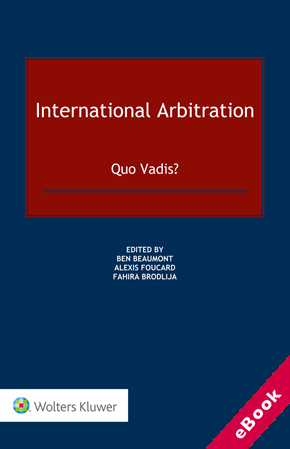
International Arbitration: Quo Vadis? delves into policy and procedural developments in commercial arbitration, investor-State arbitration and the WTO, providing insights into most recent reforms and trends. In the spirit of Pieter Sanders’s classic Quo Vadis Arbitration? (1999), this far-reaching overview of the state of international arbitration thoroughly assesses the current condition and prospects of arbitration and conciliation with practical, insightful solutions to the new and emerging problems confronting arbitration practice today.
A distinguished group of internationally renowned arbitrators, academics, and lawmakers elucidate the ubiquitous evolution towards increased technical complexity, the need for multi-focal and multi-cultural approaches, and the tension between desirable simplicity and required precision that has come to characterize current arbitral practice and procedure. Among the topics covered are the following:
As Sanders’s 1999 book did at the time, the chapters identify specific improvements and refinements to the entire system as it has developed over recent decades.
Traversing the development path of international arbitration and touching upon key procedural trends, the book will be a go-to resource for the arbitration community worldwide as a stocktaking of current and ongoing trends in international arbitration. The book’s lasting value and interest will make it a valuable resource for arbitral institutions, academics, arbitrators, arbitration counsel, and participants in international commercial arbitration. It will enthuse the many lawyers, judges, legislators, and business people to whom it is addressed.











