
The eBooks we sell are sold as a single-user licence and are intended for the end user only.
The sale of some eBooks are restricted to certain countries. To alert you to such restrictions, please select the country of the billing address of your credit or debit card you wish to use for payment.
For further information see https://www.wildy.com/ebook-formats
Once the order is confirmed an e-mail will be sent to you to allow you to download the eBook. For UK purchases this will be automatic. For purchases outside the UK a member of staff will need to confirm the sale. (Staff are available to do this during normal business hours, Mon-Fri 8:30-17:00 UK time)
All eBooks are supplied firm sale and cannot be returned. If you believe there is a fault with your eBook then contact us on ebooks@wildy.com and we will help in resolving the issue. This does not affect your statutory rights.
Due to a technical issue some ebooks are not available to order.
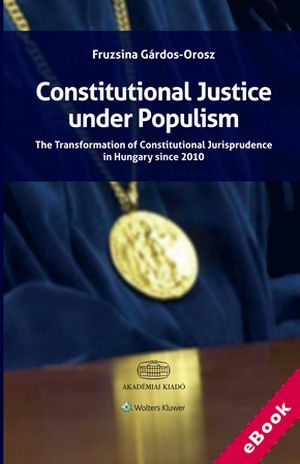
The transformation of the Hungarian Constitutional Court and its jurisprudence can be followed in chronological order in this book. The author provides a timeline and a European context to describe how the perception of Hungarian constitutional adjudication between 2010 and 2022 changed by interpreting he general development of populist constitutionalism, the new constitutional order of the successive Orban governments, which have enjoyed a two-thirds, i.e. a constituent majority in Parliament since 2010. Besides populism, the author also discusses other new challenges, such as the effects of the financial crisis, the migration crises or the Covid-19 pandemic on constitutional review.
The first chapter of the book presents the basic concepts of constitutional review in a historical and theoretical-dogmatic approach. The second chapter describes the changes in the law governing the Hungarian Constitutional Court. The third chapter focuses on the key issues in the redefinition of constitutional review and related jurisprudence in the 2010–2022 period. The fourth chapter of the book examines the nature and experience of a new trend in constitutional adjudication, the German-type constitutional complaint procedure. The fifth chapter asks how the constitutional review of legislation and judicial decisions has evolved in major and politically sensitive cases such as the economic crisis, the terrorist threat or the pandemic, in which a two-thirds government majority has settled conflicting socio-economic relations through crisis legislation. This is not only the case in Hungary, but also elsewhere in Europe as well, which is why in this chapter the author presents the results of studies on the practice of the constitutional courts of some EU member states and of the Strasbourg and Luxembourg courts. This is in order to understand more fully in what respects and in which cases the Hungarian Constitutional Court’s practice has been unique.
The volume concludes that the nature of today’s Hungarian Constitutional Court – due to the constraints of the changed political and constitutional environment – is closer to a constitutional advisory body orienting the jurisprudence of the ordinary courts than to a Kelsen-type constitutional court limiting Government by effective constitutional review.










