
The eBooks we sell are sold as a single-user licence and are intended for the end user only.
The sale of some eBooks are restricted to certain countries. To alert you to such restrictions, please select the country of the billing address of your credit or debit card you wish to use for payment.
For further information see https://www.wildy.com/ebook-formats
Once the order is confirmed an e-mail will be sent to you to allow you to download the eBook. For UK purchases this will be automatic. For purchases outside the UK a member of staff will need to confirm the sale. (Staff are available to do this during normal business hours, Mon-Fri 8:30-17:00 UK time)
All eBooks are supplied firm sale and cannot be returned. If you believe there is a fault with your eBook then contact us on ebooks@wildy.com and we will help in resolving the issue. This does not affect your statutory rights.
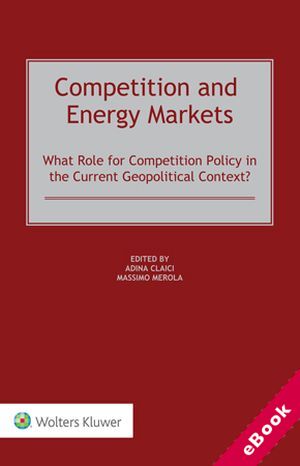
Competition and Energy Markets is a pivotal and timely volume that provides guidance on how to address the crucial trade-offs that arise when competition policy meets other challenging European objectives. The extraordinary double crisis of the COVID-19 pandemic and the war in Ukraine has given rise to an unusual geopolitical dilemma for the EU institutions – especially in the energy sector – of ensuring the security of energy supply and upholding committed emission targets concurrently.
What’s in this book:
This compendium comprises contributions from eminent practitioners and academics, members of the European Commission, and representatives of national competition authorities, who address various issues around the new energy dilemma concerning the following aspects:
The book is a revision of papers and presentations given at the 2023 Annual Conference of the Global Competition Law Center (GCLC) of the College of Europe.
How this will help you:
Although other constraints beyond the security of supply and the path towards a green economy exist, they do not alter the trade-offs’ existence but make them even more problematic and unavoidable. Consequently, all professionals and officials shaping energy policy will greatly appreciate this invaluable book. For practitioners, policymakers and academics working on competition law, the book will provide valuable food for thought and guidance in the years ahead.











