
The eBooks we sell are sold as a single-user licence and are intended for the end user only.
The sale of some eBooks are restricted to certain countries. To alert you to such restrictions, please select the country of the billing address of your credit or debit card you wish to use for payment.
For further information see https://www.wildy.com/ebook-formats
Once the order is confirmed an e-mail will be sent to you to allow you to download the eBook. For UK purchases this will be automatic. For purchases outside the UK a member of staff will need to confirm the sale. (Staff are available to do this during normal business hours, Mon-Fri 8:30-17:00 UK time)
All eBooks are supplied firm sale and cannot be returned. If you believe there is a fault with your eBook then contact us on ebooks@wildy.com and we will help in resolving the issue. This does not affect your statutory rights.
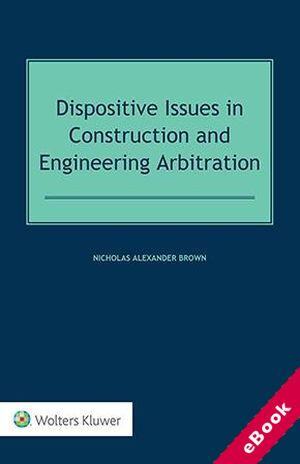
Dispositive Issues in Construction and Engineering Arbitration is a very welcome book by an internationally renowned practitioner in the field, showing that resolving construction and engineering disputes, which stem from a multi-layered tangle of issues that reflect the myriad challenges of getting a complex project built, lies in managing and mastering the factual complexity with suitable rigour.
What’s in this book:
Drawing on a rich career-long experience supported by comparative analysis of case law and institutional guidance, the author offers insights directly gained from work in a broad range of jurisdictions. He expertly identifies and frames issues that genuinely determine outcomes, reducing distraction and inefficiency, in disputes arising in various contexts, including the following:
Numerous visual aids and practical illustrations are provided, along with adaptable templates and procedural models designed for use throughout an arbitration. These address cost and complexity through proportionate, structured approaches to managing arbitration procedure and maintaining equality and procedural fairness.
How this will help you:
With its clear taxonomy of factual, legal, and expert issues as the foundation of sound arbitral decision-making, this book helps practitioners to focus on the true points in dispute, in the process embracing innovation, suitably robust case management, and cost control. It is a veritable goldmine of practical guidance for arbitrators, counsel, expert witnesses, and the business users of arbitral services worldwide, and indeed for anyone interested in mitigating the escalating costs and procedural challenges besetting commercial arbitral practice today.










