
The eBooks we sell are sold as a single-user licence and are intended for the end user only.
The sale of some eBooks are restricted to certain countries. To alert you to such restrictions, please select the country of the billing address of your credit or debit card you wish to use for payment.
For further information see https://www.wildy.com/ebook-formats
Once the order is confirmed an e-mail will be sent to you to allow you to download the eBook. For UK purchases this will be automatic. For purchases outside the UK a member of staff will need to confirm the sale. (Staff are available to do this during normal business hours, Mon-Fri 8:30-17:00 UK time)
All eBooks are supplied firm sale and cannot be returned. If you believe there is a fault with your eBook then contact us on ebooks@wildy.com and we will help in resolving the issue. This does not affect your statutory rights.
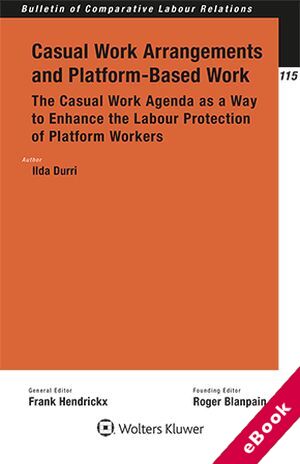
Casual Work Arrangements and Platform-Based Work is a trailblazing book offering in-depth research on specifically positioning platform work in the context of casual work arrangements. Platform work – in which work activities are channelled through web platforms or apps – has emerged as one of the major transitions in the world of work over the past decade. It presents several labour law issues related to casual work, often linked to insecure or precarious working conditions, such as unpredictable work schedules, an insecurity of work for the future, the lack of a stable income, and exclusion from even basic protections The author meticulously evaluates how strategies aimed at regulating casual work can be extended to enhance these insecure working conditions faced by platform workers.
What’s in this book:
In a nutshell, the issues and topics covered include the following:
This compendium is a thorough comparative legal analysis of casual work in four industrialized countries – the United Kingdom, the Netherlands, Belgium, and Italy – elucidating the divergent regulatory approaches to this work typology. Further, the book furnishes EU legislators’ efforts to establish a regulatory matrix on casual work, focusing on directives such as those on fixed-term work, working time, and transparent and predictable working conditions. The author sums it up with recommendations for redefining the EU legal initiative on platform work, in light of the national and EU legal instruments examined in this contribution. Issues, such as the insecure nature of work, unpaid standby time, and work insecurity, come to light.
How this will help you:
This vital book will aid policymakers and social partners to identify viable legal solutions to combat some of the labour protection challenges posed by platform work. At the same time, it will prove to be a reminder to EU policymakers that existing legal instruments on casual work constitute an available blueprint which could be beneficial in dealing with such regulatory difficulties. Finally, it will also provide legal scholars with an important insight into looking at platform work through the lens of casual work.











