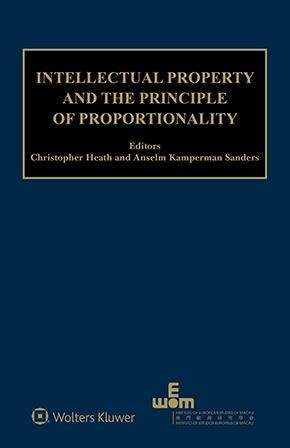
Intellectual Property and the Principle of Proportionality is a book in which a group of distinguished international scholars and practitioners provides in-depth analysis and critical assessment of how legislation, substantive law, and enforcement provisions, as understood in international and European law, affect the application of the principle of proportionality to intellectual property rights. As a core principle of law in general, proportionality aims at achieving a mutually acceptable balance between different and competing interests. In the case of intellectual property rights, these are the interests of rights owners, competitors, consumers, and the public at large.
The book presents twelve papers, as revised and updated, originally presented at conferences of the Institute of European Studies of Macau (IEEM). The subjects covered include the following:
Linking proportionality not only to the area of enforcement but to the whole field of intellectual property, the book allows the reader to appreciate this principle as one that permeates the whole system of intellectual property rights and acts as a safeguard against overly broad rights at the expense of the commons. Practitioners, academics, and policymakers worldwide will benefit from its holistic approach to the principle of proportionality in an international and comparative context.