
The eBooks we sell are sold as a single-user licence and are intended for the end user only.
The sale of some eBooks are restricted to certain countries. To alert you to such restrictions, please select the country of the billing address of your credit or debit card you wish to use for payment.
For further information see https://www.wildy.com/ebook-formats
Once the order is confirmed an e-mail will be sent to you to allow you to download the eBook. For UK purchases this will be automatic. For purchases outside the UK a member of staff will need to confirm the sale. (Staff are available to do this during normal business hours, Mon-Fri 8:30-17:00 UK time)
All eBooks are supplied firm sale and cannot be returned. If you believe there is a fault with your eBook then contact us on ebooks@wildy.com and we will help in resolving the issue. This does not affect your statutory rights.
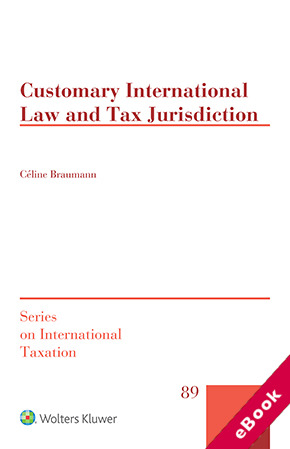
Customary International Law and Tax Jurisdiction is a book portraying the most exhaustive and robust empirical analysis of customary international tax law to date. Little attention has been paid to the pervasive effects of customary international law in contemporary issues of international taxation. Customary international law influences states’ bargaining power in treaty negotiations, serves as a gap-filler for issues not regulated by treaties, and informs the interpretation of tax treaties by judges and administrative agencies.
Employing a novel and carefully theorized methodology for the identification of customary international law concerning international tax law, the author approaches the subject through an assessment of three crucial jurisdictional issues:
A central contribution of this book is its new data set that compares the relevant practices of 80 states, providing a much larger and more geographically representative sample than any previous study. Additionally, the book comprises a comprehensive discussion on how customary limits to tax jurisdiction relate to current reform proposals spearheaded by the OECD/G20 Inclusive Framework and by the UN General Assembly, as well as unilateral measures such as digital services taxes; it thereby offers new insights to the debate on their conformity or divergence from the normative status quo of international tax law.
In essence, this book strives to encourage intra-disciplinary dialogue between international tax lawyers and public international lawyers by furnishing an accessible analysis of a complex interaction – a feature that will benefit academics and policymakers in both fields.










