
The eBooks we sell are sold as a single-user licence and are intended for the end user only.
The sale of some eBooks are restricted to certain countries. To alert you to such restrictions, please select the country of the billing address of your credit or debit card you wish to use for payment.
For further information see https://www.wildy.com/ebook-formats
Once the order is confirmed an e-mail will be sent to you to allow you to download the eBook. For UK purchases this will be automatic. For purchases outside the UK a member of staff will need to confirm the sale. (Staff are available to do this during normal business hours, Mon-Fri 8:30-17:00 UK time)
All eBooks are supplied firm sale and cannot be returned. If you believe there is a fault with your eBook then contact us on ebooks@wildy.com and we will help in resolving the issue. This does not affect your statutory rights.
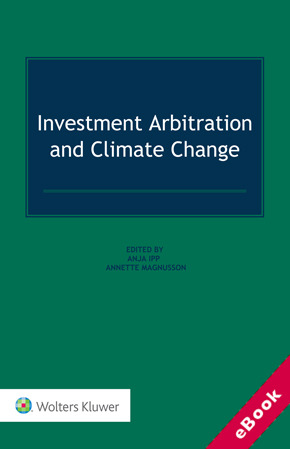
Investment Arbitration and Climate Change is a comprehensive elaboration wherein stellar experts and practitioners describe different types of climate-related investment disputes, provide a thorough analysis of the unique procedural issues that emerge in such disputes, and evaluate the proper balance between States’ right to regulate to fight climate change and their obligations towards foreign investors. At the nexus between international investment law, climate law, and human rights law, States’ obligations to protect foreign investments clash with their right – or even their duty – to regulate to protect the planet and people. State efforts at climate change mitigation and adaptation have already triggered liability claims under the investor-protection provisions of bilateral and multilateral investment treaties.
What’s in this book:
Every contribution of this book furnishes a penetrating perspective on this complex matter, elucidating the following aspects:How this will help you:
Along the way, arbitrators and other practitioners will gain insight into how to argue, defend, and assess climate-related investment disputes using investment-treaty case law and international climate agreements, human rights law, and environmental law. Policymakers are shown ways to design and implement climate policy and investment treaties to avoid claims by foreign investors.
For policymakers, treaty and contract negotiators, dispute resolution lawyers, and international organizations, no other resource provides such incisive discussion of balancing treaty-based investment protection against states’ inherent duty to regulate in the public interest.










