
The eBooks we sell are sold as a single-user licence and are intended for the end user only.
The sale of some eBooks are restricted to certain countries. To alert you to such restrictions, please select the country of the billing address of your credit or debit card you wish to use for payment.
For further information see https://www.wildy.com/ebook-formats
Once the order is confirmed an e-mail will be sent to you to allow you to download the eBook. For UK purchases this will be automatic. For purchases outside the UK a member of staff will need to confirm the sale. (Staff are available to do this during normal business hours, Mon-Fri 8:30-17:00 UK time)
All eBooks are supplied firm sale and cannot be returned. If you believe there is a fault with your eBook then contact us on ebooks@wildy.com and we will help in resolving the issue. This does not affect your statutory rights.
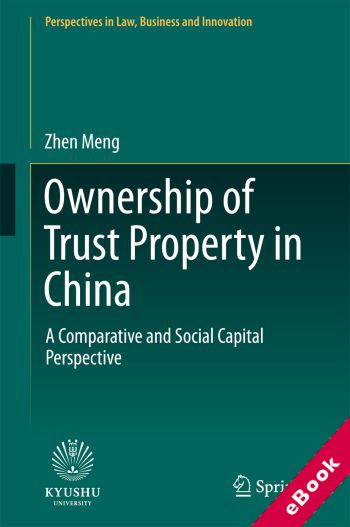
This book presents a hotly debated issue concerning the ownership of trust property in China. The book describes various conventional interpretations of Chinese Trust Law submitted by legal scholars and compares diverse approaches regarding the ownership of trust property provided by jurisdictions globally. The book does not directly answer the question "Who is the owner of trust property in China?" Instead, using a social capital perspective, it develops a more practical perspective to explain why Chinese trust business has grown rapidly even in lack of legal certainty regarding the location of ownership of trust property.
The book also further predicts under what conditions is the time ripe to clarify the location of the ownership of trust property in China.By employing those sociological concepts often used to depict and analyze society, this book outlines the structure of the Chinese trust business and related social relations in different stages, i.e., the current rapid development stage, and the possible transitional stage in the near future. The focus is on how the social network structure affects the behavior of actors (such as the settlor, the trustee, and the beneficiaries, and/or their potential candidates) within the relevant section of Chinese society.
The book provides readers with an intensive analysis of the impacts of historical, cultural, and social elements on the legislation and development of trust law in China. It will appeal both to lawyers interested in the Chinese trust business and to comparative law researchers and social scientists.











