
The eBooks we sell are sold as a single-user licence and are intended for the end user only.
The sale of some eBooks are restricted to certain countries. To alert you to such restrictions, please select the country of the billing address of your credit or debit card you wish to use for payment.
For further information see https://www.wildy.com/ebook-formats
Once the order is confirmed an e-mail will be sent to you to allow you to download the eBook. For UK purchases this will be automatic. For purchases outside the UK a member of staff will need to confirm the sale. (Staff are available to do this during normal business hours, Mon-Fri 8:30-17:00 UK time)
All eBooks are supplied firm sale and cannot be returned. If you believe there is a fault with your eBook then contact us on ebooks@wildy.com and we will help in resolving the issue. This does not affect your statutory rights.
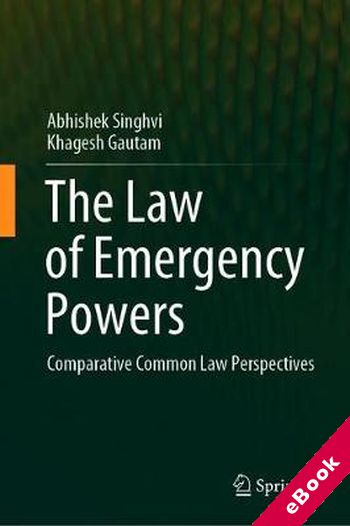
This book presents a comprehensive legal and constitutional study of emergency powers from a comparative common law perspective. It is one of very few comparative studies on three jurisdictions and arguably the first one to explore in detail various emergency powers, statutory and common law, constitutional and statutory law, martial law and military acting-in-aid of civil authority, wartime and peacetime invocations, and several related and vital themes like judicial review of emergency powers (existence, scope and degree). The three jurisdictions compared here are: the pure implied common law model (employed by the UK), implied constitutional model (employed by the USA) and the explicit constitutional model (employed by India). The book's content has important implications, as these three jurisdictions collectively cover the largest population within the common law world, and also provide maximum representative diversity. The book covers the various positions on external emergencies as opposed to internal emergencies, economic/financial emergencies, and emergent inroads being made into state autonomy by the central or federal governments, through use of powers like Article 356 of the Indian Constitution.
By providing a detailed examination of the law and practice of emergency powers, the book shares a wealth of valuable insights. Specific sub-chapters address questions like - what is the true meaning of 'martial law'; who can invoke 'martial law'; when can it be invoked and suspended; what happens when the military is called in to aid civilian authorities; can martial law be deemed to exist or coexist when this happens; what are the limits on state powers when an economic emergency is declared; and, above all, can, and if so, when and how should courts judicially review emergency powers? These and several other questions are asked and answered in this study. Though several checks and constraints have been devised regarding the scope and extent of 'emergency powers,' these powers are still prone to misuse, as all vast powers are. A study of the legal propositions on this subject, especially from a comparative perspective, is valuable for any body politic that aspires to practice democracy, while also allowing constitutionally controlled aberrations to protect that democracy.











