
The eBooks we sell are sold as a single-user licence and are intended for the end user only.
The sale of some eBooks are restricted to certain countries. To alert you to such restrictions, please select the country of the billing address of your credit or debit card you wish to use for payment.
For further information see https://www.wildy.com/ebook-formats
Once the order is confirmed an e-mail will be sent to you to allow you to download the eBook. For UK purchases this will be automatic. For purchases outside the UK a member of staff will need to confirm the sale. (Staff are available to do this during normal business hours, Mon-Fri 8:30-17:00 UK time)
All eBooks are supplied firm sale and cannot be returned. If you believe there is a fault with your eBook then contact us on ebooks@wildy.com and we will help in resolving the issue. This does not affect your statutory rights.
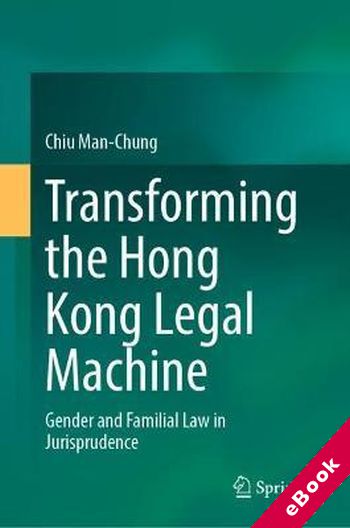
This book examines the law in relation to how it has responded to sexual and gender issues in the context of Hong Kong, and addresses the implications of those responses for the global context. It aims to develop a localized theory of justice which enables the analysis of multiple socio-legal issues arising in Hong Kong, a predominantly Han-Chinese society in Greater China, while also offering formulations for corresponding solutions. Unlike other books on Hong Kong jurisprudence and socio-legal studies, this book not only compares and contrasts different theories of justice, but also attempts to generate a philosophical perspective which can synchronize and re-organize a range of theoretical components via the lens of localisation. The author investigates theories of justice developed, respectively, by Rawls, Deleuze, Lacan, Zizek and from the perspective of Mahayana Buddhism, as well as (Orthodox) Han-Chinese Daoism. The book applies these theoretical perspectives in analyzing different socio-legal issues in post-97 Hong Kong, including transgender rights to marriage, domestic violence, sexual assault, child sexual abuse and race. The book concludes by proposing singular possible strategies, which include degenderization, desexualization, de-ageing, by which justice(s) can hopefully be re-manufactured and challenged. This book is relevant to researchers and students of law, philosophy, sociology, gender studies and cultural studies.











