
The eBooks we sell are sold as a single-user licence and are intended for the end user only.
The sale of some eBooks are restricted to certain countries. To alert you to such restrictions, please select the country of the billing address of your credit or debit card you wish to use for payment.
For further information see https://www.wildy.com/ebook-formats
Once the order is confirmed an e-mail will be sent to you to allow you to download the eBook. For UK purchases this will be automatic. For purchases outside the UK a member of staff will need to confirm the sale. (Staff are available to do this during normal business hours, Mon-Fri 8:30-17:00 UK time)
All eBooks are supplied firm sale and cannot be returned. If you believe there is a fault with your eBook then contact us on ebooks@wildy.com and we will help in resolving the issue. This does not affect your statutory rights.
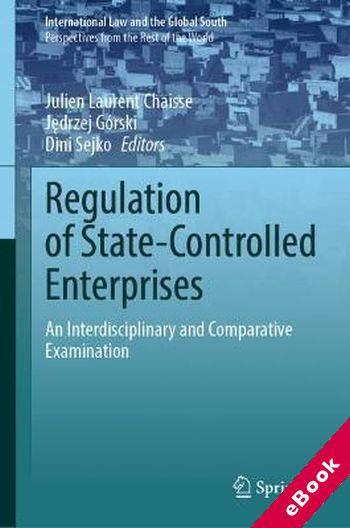
This book analyses actual and potential normative (whether legislative or contractual) conflicts and complex transnational disputes related to state-controlled enterprises (SCEs) operations and how they are interwoven with the problem of foreign direct investment. Moreover, SCEs also fall within the remit of international political economy, international economics and other SCE-related fields that go beyond purely legal or regulatory matters. In this connection, research on such economic and political determinants of SCE's operations greatly informs and supplements the state of knowledge on how to best regulate cross-border aspects of SCE's and is also be covered in this book.
The book also aims to analyse the "SCE phenomenon" which includes a wide panoply of entities that have various structures with different degrees of control by states at the central or regional level, and that critically discuss the above-mentioned overlapping legal economic and political systems which can emerge under various shades of shadows casted by governmental umbrellas (i.e., the control can be exercised through ownership, right to appoint the management, and special-voting-rights).
The chapters in this book are grouped, so as to address cross-border investment by and in SCE, into four coherent major parts, namely --- (i) the regulatory framework of state capitalism: laws, treaties, and contracts; (ii) economic and institutional expansion of state capitalism; (iii) the accountability of state capitalism: exploring the forms of liabilities; and (iv) regional and country perspectives. Contributions address the core theme from a broad range of SCE and international economic regulations, including but not limited to competition law, WTO law, investment law, and financial/monetary law. They also cover the new emerging generation of Free Trade Agreements (EU-Vietnam FTA, EU China investment treaty, Regional Comprehensive Economic Partnership; and the coordination between treaty systems). The book is a valuable addition and companion for courses, such as international trade law, international law of foreign investment, transnational law, international and economic development, world politics, law of preferential trade agreements, international economics, and economics of development.










