Wildy Logo
(020) 7242 5778
enquiries@wildy.com

Book of the Month

Cover of Collective Litigation: A Practical Guide

Collective Litigation: A Practical Guide

Price: £250.00

Planning Law:
A Practitioner's
Handbook 2nd ed


 William Webster, Robert Weatherley


Welcome to Wildys

Watch


Corporate Insolvency Practice:
Litigation, Procedure
and Precedents 3rd ed


 Mark Watson-Gandy


Offers for Newly Called Barristers & Students

Special Discounts for Newly Called & Students

Read More ...


Secondhand & Out of Print

Browse Secondhand Online

Read More...


August bank holiday

We will be closed from 5pm BST on Friday 28th August 2026 for the late summer bank holiday, re-opening at 8.30am BST on Tuesday 1st September. Any orders placed during this period will be processed when we re-open.
Hide this message

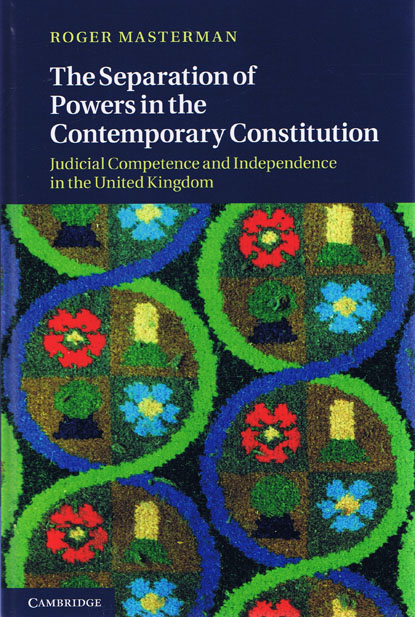
The Separation of Powers in the Contemporary Constitution: Judicial Competence and Independence in the United Kingdom


ISBN13: 9780521493376
Published: December 2010
Publisher: Cambridge University Press
Country of Publication: UK
Format: Hardback
Price: £109.00


Despatched in 6 to 8 days.

Roger Masterman examines the dividing lines between the powers of the judicial branch of government and those of the executive and legislative branches in the light of two of the most significant constitutional reforms of recent years: the Human Rights Act (1998) and Constitutional Reform Act (2005).

Both statutes have implications for the separation of powers within the United Kingdom constitution. The Human Rights Act brings the judges into much closer proximity with the decisions of political actors than previously permitted by the Wednesbury standard of review and the doctrine of parliamentary sovereignty, while the Constitutional Reform Act marks the emergence of an institutionally independent judicial branch.

Taken together, the two legislative schemes form the backbone of a more comprehensive system of constitutional checks and balances policed by a judicial branch underpinned by the legitimacy of institutional independence.

Subjects:
Constitutional and Administrative Law
Contents:
Introduction
1. A doctrine of uncertain scope and application
2. The Human Rights Act 1998 and the separation of powers
3. The Strasbourg influence
4. Justiciability
5. Deference and proportionality
6. Statutory interpretation and declarations of incompatibility
7. Developing the common law and the meaning of 'the convention rights'
8. The independence of the judiciary
9. Towards constitutional separation.