
Wildy Logo
(020) 7242 5778
enquiries@wildy.com

Book of the Month

Cover of Toulson & Phipps on Confidentiality

Toulson & Phipps on Confidentiality

Price: £175.00

Advocacy: A Practical
Guide 2nd ed


 Peter Lyons, Chris Taylor


Welcome to Wildys

Watch


Judicial Cooperation in Commercial Litigation 3rd ed (The British Cross-Border Financial Centre World)


 Ian Kawaley, David Doyle, Shade Subair Williams


Offers for Newly Called Barristers & Students

Special Discounts for Newly Called & Students

Read More ...


Secondhand & Out of Print

Browse Secondhand Online

Read More...


Easter Holiday Closing

We will be closed from 5pm BST on Thursday 2nd April for the Easter bank holidays, re-opening at 8.30am BST on Tuesday 7th April. Any orders placed during this period will be processed when we re-open.

Hide this message

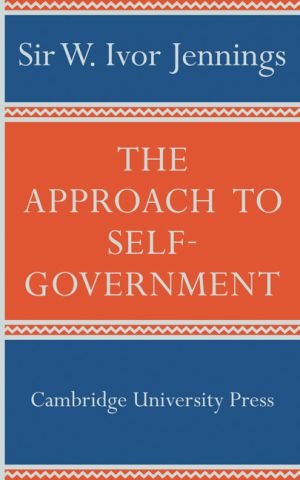
The Approach to Self-Government


ISBN13: 9780521241915
Published: June 2011
Publisher: Cambridge University Press
Country of Publication: UK
Format: Paperback
Price: £40.00


Despatched in 7 to 9 days.

During his lifetime, Sir Ivor Jennings (1903–1965) was well known as the author of several standard books on constitutional law. He acted as constitutional adviser to the governments of Ceylon and Pakistan and was Vice-Chancellor of the University of Ceylon. This 1956 book followed in the tradition of his earlier The British Constitution and is a clear statement by an expert with a characteristically practical point of view. It is principally concerned with a practical problem: what constitution shall be given to a new country about to govern itself for the first time? Published at a time when colonial empires were moving more or less peaceably towards self-government, it was based on a series of broadcast talks originally commissioned by the BBC in the belief that the experiences gained in Asia were in principle applicable to other countries approaching self-government.


Subjects:
Public International Law
Contents:
Preface
1. The problem
2. The people
3. The unit of government
4. Elections
5. Communalism in elections
6. A bill of rights
7. The legislature
8. Administration
9. Educational development
10. Executive government
11. The dilemma of representative government
12. The transition
Index.







