
The eBooks we sell are sold as a single-user licence and are intended for the end user only.
The sale of some eBooks are restricted to certain countries. To alert you to such restrictions, please select the country of the billing address of your credit or debit card you wish to use for payment.
For further information see https://www.wildy.com/ebook-formats
Once the order is confirmed an e-mail will be sent to you to allow you to download the eBook. For UK purchases this will be automatic. For purchases outside the UK a member of staff will need to confirm the sale. (Staff are available to do this during normal business hours, Mon-Fri 8:30-17:00 UK time)
All eBooks are supplied firm sale and cannot be returned. If you believe there is a fault with your eBook then contact us on ebooks@wildy.com and we will help in resolving the issue. This does not affect your statutory rights.
Due to a technical issue some ebooks are not available to order.
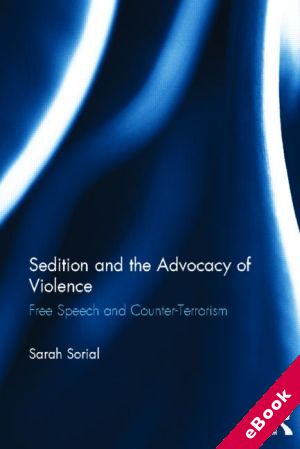
This book employs the theoretical framework of ‘speech act theory’ to analyse current legislative frameworks and cases pertaining to sedition or the advocacy of violence and the issue of freedom of speech.
An analysis of the relation between speech and action offers a promising way of clarifying confusion over the contested status of speech, which advocates violence as a political strategy. This account reflects an understanding of philosophical issues about both the nature of freedom and speech and how these issues can be applied to concrete legal problems.
This approach will shed new light on the problems of the sedition laws and how they might be remedied by providing a conceptual account of the nature of speech and its relation to action. On the basis of J.L Austin’s account of verdictive and exercitive speech acts, it is argued that while all speech acts are ‘conduct’ in a narrow sense, not all of them have the power to produce effects.
This philosophical account will have legal consequences for how we classify speech acts deemed to be dangerous, or to cause harm. It also suggests that because speech can evoke or constitute action or conduct in certain circumstances, modern versions of sedition laws might in principle be defensible, but not in their current form. On the basis of this account, it is argued that the harms caused or constituted by speech can be located in the authority of the speaker.










