The eBooks we sell are sold as a single-user licence and are intended for the end user only.
The sale of some eBooks are restricted to certain countries. To alert you to such restrictions, please select the country of the billing address of your credit or debit card you wish to use for payment.
For further information see https://www.wildy.com/ebook-formats
Once the order is confirmed an e-mail will be sent to you to allow you to download the eBook. For UK purchases this will be automatic. For purchases outside the UK a member of staff will need to confirm the sale. (Staff are available to do this during normal business hours, Mon-Fri 8:30-17:00 UK time)
All eBooks are supplied firm sale and cannot be returned. If you believe there is a fault with your eBook then contact us on ebooks@wildy.com and we will help in resolving the issue. This does not affect your statutory rights.
Due to a technical issue some ebooks are not available to order.
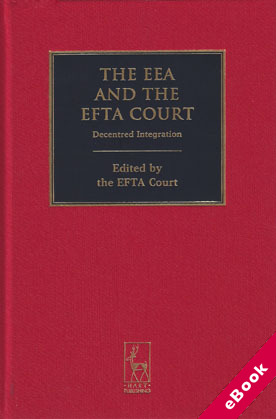
The EEA Agreement extends the free movement of persons, goods, services and capital to the EEA/EFTA States, Iceland, Liechtenstein and Norway. It provides fair competition and abolishes discrimination on grounds of nationality in all 31 EEA States.
The successful operation of the EEA depends upon a two-pillar system of supervision involving the European Commission and the EFTA Surveillance Authority. A two-pillar structure has also been established in respect of judicial control; the EFTA Court operates in parallel to the Court of Justice of the European Union.
The EFTA Court, which celebrates its 20th anniversary in 2014, has jurisdiction with regard to EFTA States which are parties to the EEA Agreement. The jurisdiction of the EFTA Court mainly corresponds to the jurisdiction of the Court of Justice of the European Union over EU States. The EFTA Court consists of three Judges, one nominated by each of the EFTA States party to the EEA Agreement.
The essays in this collection, assembled to celebrate the 20 year landmark, review the successes and shortcomings of the Court, its interface with EU law, and the prospects for its future development.