The eBooks we sell are sold as a single-user licence and are intended for the end user only.
The sale of some eBooks are restricted to certain countries. To alert you to such restrictions, please select the country of the billing address of your credit or debit card you wish to use for payment.
For further information see https://www.wildy.com/ebook-formats
Once the order is confirmed an e-mail will be sent to you to allow you to download the eBook. For UK purchases this will be automatic. For purchases outside the UK a member of staff will need to confirm the sale. (Staff are available to do this during normal business hours, Mon-Fri 8:30-17:00 UK time)
All eBooks are supplied firm sale and cannot be returned. If you believe there is a fault with your eBook then contact us on ebooks@wildy.com and we will help in resolving the issue. This does not affect your statutory rights.
Due to a technical issue some ebooks are not available to order.
The institutional shortcomings of the World Trade Organization (WTO) became apparent during the Doha Round of Trade negotiations that began in 2001 and which aimed to improve the success of developing countries' trading by lowering trade barriers and adjusting other trade rules. This <"development agenda>" meant different things to rich and poor countries. In addition, many of the circumstances that supported success in General Agreement on Tariffs and Trade (GATT) negotiations of 1947 were no longer present after the WTO was founded in 1995.
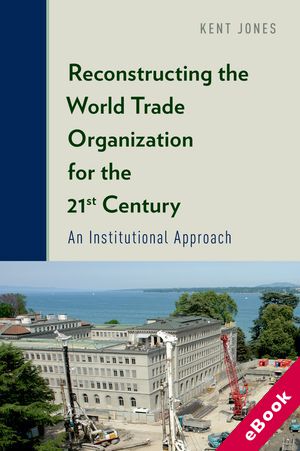
In Reconstructing the World Trade Organization for the 21st Century, Kent Jones examines the difficulties of the WTO in completing multilateral trade negotiations and possible ways to restore its ability to do so. The problem lies in the institutional structure it inherited from the GATT, which was designed for a more limited scope of trade negotiations among a relatively small number of wealthier, industrialized countries. Jones presents an institutional model of the GATT/WTO system, which describes why such an organization exists and how it is supposed to accomplish its goals. Institutional reforms will be necessary to restore the WTO's ability to complete global trade agreements, including a more flexible application of the consensus rule, a common understanding among all members about the limits of domestic policy space that is subject to negotiation, and clearer rules on reciprocity obligations. The popularity of bilateral and regional trade agreements, which have emerged as the alternative to WTO agreements, presents a threat to the WTO's relevance in trade negotiations, but also an opportunity to "multilateralize" new and deeper trade integration in future WTO agreements. Aid for trade may also play an instrumental role in bringing more developing countries into WTO disciplines. Above all, WTO members must develop new ways to find common ground in order to negotiate for mutual gains from trade.