The eBooks we sell are sold as a single-user licence and are intended for the end user only.
The sale of some eBooks are restricted to certain countries. To alert you to such restrictions, please select the country of the billing address of your credit or debit card you wish to use for payment.
For further information see https://www.wildy.com/ebook-formats
Once the order is confirmed an e-mail will be sent to you to allow you to download the eBook. For UK purchases this will be automatic. For purchases outside the UK a member of staff will need to confirm the sale. (Staff are available to do this during normal business hours, Mon-Fri 8:30-17:00 UK time)
All eBooks are supplied firm sale and cannot be returned. If you believe there is a fault with your eBook then contact us on ebooks@wildy.com and we will help in resolving the issue. This does not affect your statutory rights.
Due to a technical issue some ebooks are not available to order.
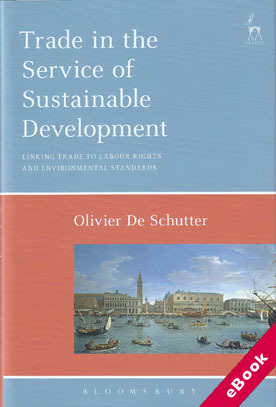
This book examines the fragmentation of international regimes, looking specifically at the failure to create effective linkages between the multilateral trade regime, on the one hand, and universally recognized labour and environmental standards, on the other.
Trade liberalization has proceeded through bilateral and regional trade agreements, as well as through successive rounds of multilateral negotiations of both the GATT and now the WTO.
Labour rights have been gradually defined at international level under the auspices of the International Labour Organization, which since its establishment led to the conclusion hundreds of instruments open for signature and ratification. Environmental standards have been set in a range of conventions, covering a range of areas including the protection of the ozone layer, hazardous waste, endangered species, biodiversity and climate change. But these developments have hitherto remained largely separate and disconnected from one another. International trade law, international labour law, and international environmental law, coexist. These various regimes are established under specific instruments.
This book explores whether fragmentation, as it has developed since the Second World War, is an obstacle to the pursuit of sustainable development, and if so, what can be done about it.