The eBooks we sell are sold as a single-user licence and are intended for the end user only.
The sale of some eBooks are restricted to certain countries. To alert you to such restrictions, please select the country of the billing address of your credit or debit card you wish to use for payment.
For further information see https://www.wildy.com/ebook-formats
Once the order is confirmed an e-mail will be sent to you to allow you to download the eBook. For UK purchases this will be automatic. For purchases outside the UK a member of staff will need to confirm the sale. (Staff are available to do this during normal business hours, Mon-Fri 8:30-17:00 UK time)
All eBooks are supplied firm sale and cannot be returned. If you believe there is a fault with your eBook then contact us on ebooks@wildy.com and we will help in resolving the issue. This does not affect your statutory rights.
Due to a technical issue some ebooks are not available to order.
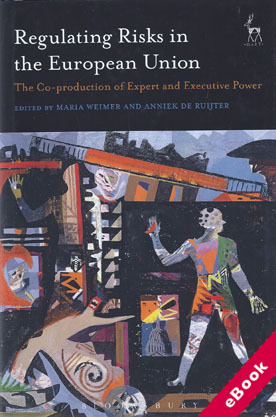
A growing body of EU law and regulation is preoccupied with the protection of EU citizens from health and environmental risks. Which chemicals are safe and should be allowed on the market? How should the EU respond to public health emergencies, such as Ebola and other infectious diseases?
Regulatory responses to these questions confront deep uncertainty, limited knowledge, and societal contestation. In a time where the use of scientific expertise in EU policy-making is particularly contested, this book offers a timely contribution to both the academic and policy debate on the role of specialized expertise in EU public decision-making on risk and technology as well as on its intertwinement with executive power. It draws on insights from law, governance, political sciences and science and technology studies, bringing together leading scholars in this field.
Contributions are drawn together by a shared theoretical perspective, namely by their use of co-production as an analytical lens to study the intricate interplay between techno-scientific expertise and EU executive power. By so doing, the collection produces highly original insights into the development of the EU administrative state, as well as into the role of regulatory science in its construction. This book will be useful to scholars, practitioners, and policy makers working on risk regulation and the role of expertise in public decision-making.