The eBooks we sell are sold as a single-user licence and are intended for the end user only.
The sale of some eBooks are restricted to certain countries. To alert you to such restrictions, please select the country of the billing address of your credit or debit card you wish to use for payment.
For further information see https://www.wildy.com/ebook-formats
Once the order is confirmed an e-mail will be sent to you to allow you to download the eBook. For UK purchases this will be automatic. For purchases outside the UK a member of staff will need to confirm the sale. (Staff are available to do this during normal business hours, Mon-Fri 8:30-17:00 UK time)
All eBooks are supplied firm sale and cannot be returned. If you believe there is a fault with your eBook then contact us on ebooks@wildy.com and we will help in resolving the issue. This does not affect your statutory rights.
Due to a technical issue some ebooks are not available to order.
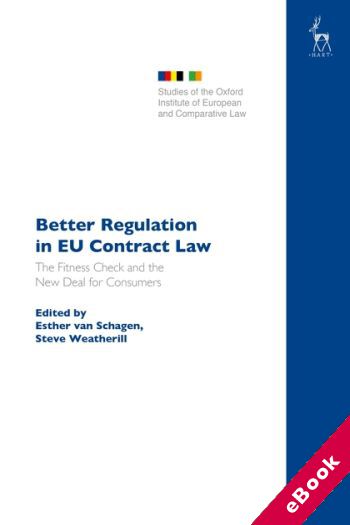
This book is the first to provide a critical investigation of EU impact assessments and better regulation from the perspective of EU contract law. The Commission's “New Deal for EU Consumers” is one of the first EU contract law initiatives to implement both the newly revised Better Regulation Guidelines and the newly introduced combined evaluation of multiple Directives in the form of a “fitness check”. This offers an opportunity to explore difficulties and best practices at national level, as demonstrated by experience with the EU's Unfair Terms Directive. Both the fitness check and the impact assessment accompanying the New Deal should facilitate critical reflection on the design of EU contract law.
This book addresses key questions such as: do impact assessments favour business interests, at the expense of a high level of consumer protection? Is the evaluation of EU contract law, and the analysis in impact assessments, in line with scientific standards? Has the fitness check revealed difficulties and success stories with EU measures at national level, and thereby facilitated an in-depth scrutiny of the design of EU contract law? Ultimately: is the potential of better regulation realised?