The eBooks we sell are sold as a single-user licence and are intended for the end user only.
The sale of some eBooks are restricted to certain countries. To alert you to such restrictions, please select the country of the billing address of your credit or debit card you wish to use for payment.
For further information see https://www.wildy.com/ebook-formats
Once the order is confirmed an e-mail will be sent to you to allow you to download the eBook. For UK purchases this will be automatic. For purchases outside the UK a member of staff will need to confirm the sale. (Staff are available to do this during normal business hours, Mon-Fri 8:30-17:00 UK time)
All eBooks are supplied firm sale and cannot be returned. If you believe there is a fault with your eBook then contact us on ebooks@wildy.com and we will help in resolving the issue. This does not affect your statutory rights.
Due to a technical issue some ebooks are not available to order.
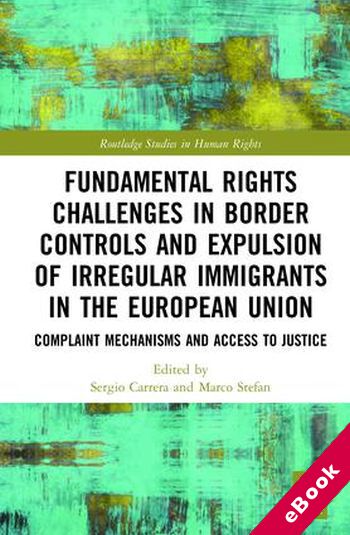
This edited volume examines the extent to which the various authorities and actors currently performing border management and expulsion-related tasks are subject to accountability mechanisms capable of delivering effective remedies and justice for abuses suffered by migrants and asylum seekers.
Member states of the European Union and State Parties to the Council of Europe are under the obligation to establish complaint mechanisms allowing immigrants and/or asylum seekers to seek effective remedies in cases where their rights are violated. This book sheds light on the complaint bodies and procedures existing and available in Austria, Greece, Hungary, Italy, Spain, Poland, and Romania. It assesses their role in overseeing, investigating, and redressing cases of human rights violations deriving from violent border and immigration management practices, and expedited expulsion procedures. This book therefore provides an assessment of the practical, legal, and procedural challenges that affect the possibility to lodge complaints and access remedies for human rights violations suffered at the hands of the law enforcement authorities and other security actors operating at land, air, and sea borders, or participating in expulsions procedures – in particular, joint return flights.
The volume will be of key interest to students, scholars, and practitioners working on human rights, migration and borders, international law, European law and security studies, EU politics, and more broadly, international relations.