The eBooks we sell are sold as a single-user licence and are intended for the end user only.
The sale of some eBooks are restricted to certain countries. To alert you to such restrictions, please select the country of the billing address of your credit or debit card you wish to use for payment.
For further information see https://www.wildy.com/ebook-formats
Once the order is confirmed an e-mail will be sent to you to allow you to download the eBook. For UK purchases this will be automatic. For purchases outside the UK a member of staff will need to confirm the sale. (Staff are available to do this during normal business hours, Mon-Fri 8:30-17:00 UK time)
All eBooks are supplied firm sale and cannot be returned. If you believe there is a fault with your eBook then contact us on ebooks@wildy.com and we will help in resolving the issue. This does not affect your statutory rights.
Due to a technical issue some ebooks are not available to order.
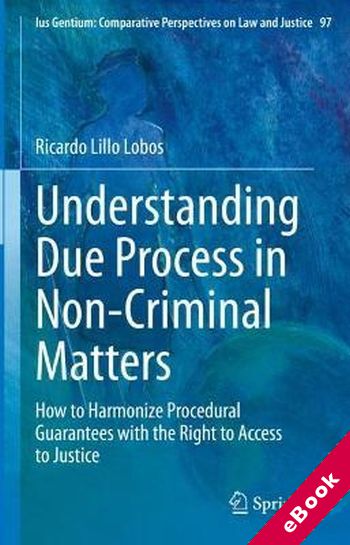
How we understand what procedure is due as a fundamental or constitutional right can have a critical impact on designing a civil procedure. Drawing on comparative law and empirically oriented methodologies, in this book the author provides a thorough analysis of how procedural due process is understood both in national jurisdictions and in the field of international human rights law.
The book offers a suitable due process theory for civil matters in general, assessing the different roles that this basic international human right plays in comparison with criminal justice. In this regard, it argues that the civil justice conception of due process has grown under the shadow of criminal justice for too long. Moreover, the theory answers the question of what the basic requirements are concerning the right to a fair trial on civil matters, i.e., the question of what we can and cannot sacrifice when designing a civil procedure that correctly distributes the risk of moral harm while remaining accessible to people with complex and simple legal needs, in order to reconcile the requirements of procedural fairness with social demands for justice.
This book makes a valuable contribution to the field of civil justice, legal design, and access to justice by providing an empirically based normative theory regarding the right to a fair trial. As such, it will be of interest to a broad audience: policymakers, practitioners and judges, but also researchers and scholars interested in theoretical questions in jurisprudence, and those familiar with empirical legal studies, comparative law, and other socio-legal studies.