The eBooks we sell are sold as a single-user licence and are intended for the end user only.
The sale of some eBooks are restricted to certain countries. To alert you to such restrictions, please select the country of the billing address of your credit or debit card you wish to use for payment.
For further information see https://www.wildy.com/ebook-formats
Once the order is confirmed an e-mail will be sent to you to allow you to download the eBook. For UK purchases this will be automatic. For purchases outside the UK a member of staff will need to confirm the sale. (Staff are available to do this during normal business hours, Mon-Fri 8:30-17:00 UK time)
All eBooks are supplied firm sale and cannot be returned. If you believe there is a fault with your eBook then contact us on ebooks@wildy.com and we will help in resolving the issue. This does not affect your statutory rights.
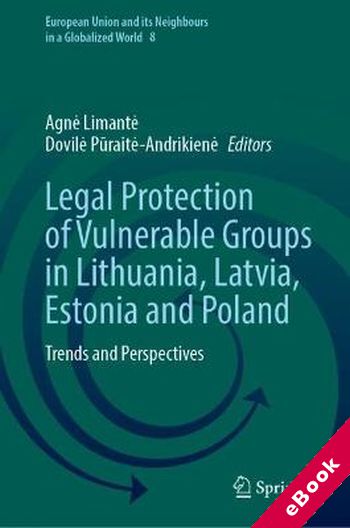
This book analyses the current legal situation and protection of vulnerable groups in Lithuania, Latvia, Estonia and Poland. In recent decades, national legislation in many European states has especially focused on vulnerable groups with the aim of securing their enhanced protection and social inclusion. This trend is also noticeable in North-Eastern Europe, where the legal frameworks are constantly being revised to address the needs of vulnerable parts of society, including women, children, the elderly, people with disabilities, and minorities, as well as prisoners and victims of crime. But despite these positive changes, many challenges persist.
In this book, the authors provide a comprehensive, comparative analysis of legal regulations and practices intended to protect vulnerable groups in Lithuania, Latvia, Estonia and Poland, and in the process, share insights into the current situation and trends in this often-overlooked region. Part I introduces readers to the topic by defining the concept of vulnerable groups and elaborating on its understanding in the European and national contexts. Part II analyses the legal protection of groups characterised by inherent and/or circumstantial vulnerability, while Part III addresses specific crime-related vulnerability issues in the target region. In closing, Part IV puts the spotlight on three specific vulnerable groups in the discussed countries.