
The eBooks we sell are sold as a single-user licence and are intended for the end user only.
The sale of some eBooks are restricted to certain countries. To alert you to such restrictions, please select the country of the billing address of your credit or debit card you wish to use for payment.
For further information see https://www.wildy.com/ebook-formats
Once the order is confirmed an e-mail will be sent to you to allow you to download the eBook. For UK purchases this will be automatic. For purchases outside the UK a member of staff will need to confirm the sale. (Staff are available to do this during normal business hours, Mon-Fri 8:30-17:00 UK time)
All eBooks are supplied firm sale and cannot be returned. If you believe there is a fault with your eBook then contact us on ebooks@wildy.com and we will help in resolving the issue. This does not affect your statutory rights.
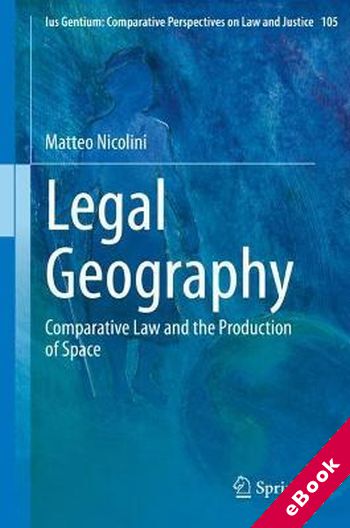
This book invites readers to critically rethink the interrelations between geography and the law. Traditionally, legal-geographical interrelations have been dominated by scholars with backgrounds in geopolitics, economics, or geography. More recently, a new interdisciplinary approach has been developed with the aim of offering a fresh perspective on how law and geography intersect. There has been a steady growth in cross-disciplinary research in this field; how legal-geographical taxonomies interrelate has attracted attention from scholars and academics with a diverse range of backgrounds - namely, law, anthropology, and human/physical geography - thus giving rise to several publications.
Against this backdrop, the book adopts a legal comparative perspective and assesses 'normative spatialities', which are the outcomes of processes of legal-spatial production. In addition, the comparative analysis offers readers new insights on some traditional geographic features which are essential to legal studies (territorial identity, regional demarcation, territorial alternation, and place-name policy). Examples are drawn from several jurisdictions (both from the Global North and the Global South) and partly employ a diachronic perspective.
As its subversive character is ideally suited to revealing policies and agendas, comparative law is used to identify the ethnocentric and colonial biases underpinning the use (and misuse) of legal geographic devices by policymakers and academics. In sum, the book presents legal geography as an interdisciplinary undertaking in which geographers and legal scholars can jointly examine common concepts in the historical, cultural, political and social contexts in which law is practised. The book transcends the boundaries between disciplines to engage in a fruitful dialogue on how the law can help to address the current socio-geographic and ecological crises.











