The eBooks we sell are sold as a single-user licence and are intended for the end user only.
The sale of some eBooks are restricted to certain countries. To alert you to such restrictions, please select the country of the billing address of your credit or debit card you wish to use for payment.
For further information see https://www.wildy.com/ebook-formats
Once the order is confirmed an e-mail will be sent to you to allow you to download the eBook. For UK purchases this will be automatic. For purchases outside the UK a member of staff will need to confirm the sale. (Staff are available to do this during normal business hours, Mon-Fri 8:30-17:00 UK time)
All eBooks are supplied firm sale and cannot be returned. If you believe there is a fault with your eBook then contact us on ebooks@wildy.com and we will help in resolving the issue. This does not affect your statutory rights.
Due to a technical issue some ebooks are not available to order.
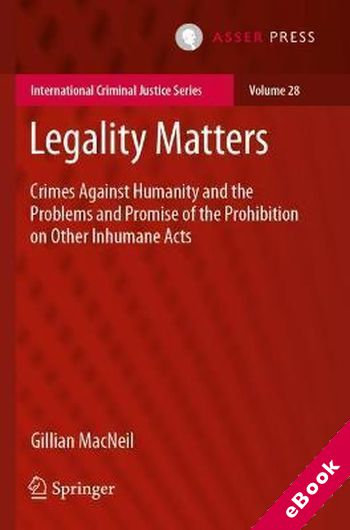
This book examines the way international criminal courts and tribunals have interpreted the crimes against humanity proscription of other inhumane acts. This clause is consistently used in spite of the long list of more specific offences forbidden as crimes against humanity.
The volume proposes that the current approach is based on a misunderstanding of the nature of the clause. Properly understood, the clause is an invitation to courts to create and apply retroactive criminal laws. This leads to a problem. A prohibition on the use of retroactive criminal laws, one which admits no exceptions, is deeply embedded in international law.
The author argues that it is time to revisit the assumption that retroactive criminal laws can never be deployed in a fair legal system. Drawing lessons from an exploration on the way the prohibition on retroactive laws is applied in practice, she proposes a new framework for understanding the clause proscribing the commission of other inhumane acts.
This book will be of relevance to anyone interested in international criminal law or criminal law theory.