The eBooks we sell are sold as a single-user licence and are intended for the end user only.
The sale of some eBooks are restricted to certain countries. To alert you to such restrictions, please select the country of the billing address of your credit or debit card you wish to use for payment.
For further information see https://www.wildy.com/ebook-formats
Once the order is confirmed an e-mail will be sent to you to allow you to download the eBook. For UK purchases this will be automatic. For purchases outside the UK a member of staff will need to confirm the sale. (Staff are available to do this during normal business hours, Mon-Fri 8:30-17:00 UK time)
All eBooks are supplied firm sale and cannot be returned. If you believe there is a fault with your eBook then contact us on ebooks@wildy.com and we will help in resolving the issue. This does not affect your statutory rights.
Due to a technical issue some ebooks are not available to order.
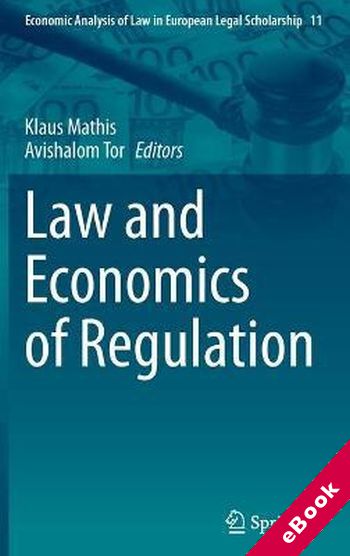
This book explores current issues regarding the regulation of various economic sectors, theoretically and empirically, discussing both neoclassical and behavioural economics approaches to regulation. Regulation has become one of the main determinants of modern economies, and virtually every sector is subject to general laws and regulations as well as specific rules and standards. A traditional argument to justify regulatory interventions is the promotion of public interests. Fixing markets that lack competition, balancing information asymmetries, internalising externalities, mitigating systemic risks, and protecting consumers from irrational behaviour are frequently invoked to complement the invisible hand of the market with the visible hand of the state.However, regulations can lead to unintended consequences, and serve the interests of powerful private interest groups rather than the public interest and social welfare. In addition, new insights from behavioural economics question the traditional regulatory approaches, most prominently in attitudes towards consumers. Furthermore, digitalisation and technological innovation in general present new challenges in terms of both the type of regulation and the regulatory process.Part I of this book discusses various theoretical approaches to the economic analysis of regulations, while Part II looks at specific applications of the law and economics of regulation.