The eBooks we sell are sold as a single-user licence and are intended for the end user only.
The sale of some eBooks are restricted to certain countries. To alert you to such restrictions, please select the country of the billing address of your credit or debit card you wish to use for payment.
For further information see https://www.wildy.com/ebook-formats
Once the order is confirmed an e-mail will be sent to you to allow you to download the eBook. For UK purchases this will be automatic. For purchases outside the UK a member of staff will need to confirm the sale. (Staff are available to do this during normal business hours, Mon-Fri 8:30-17:00 UK time)
All eBooks are supplied firm sale and cannot be returned. If you believe there is a fault with your eBook then contact us on ebooks@wildy.com and we will help in resolving the issue. This does not affect your statutory rights.
Due to a technical issue some ebooks are not available to order.
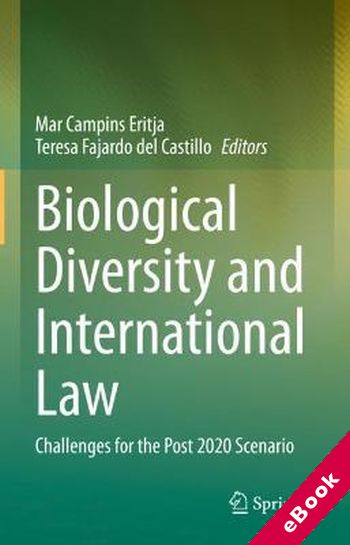
The book focuses on the interactions between international legal regimes related to biodiversity governance. It addresses the systemic challenges by analyzing the legal interactions between international biodiversity law and related international law applicable to economic activities, as well as issues related to the governance of biodiversity based on functional, normative, and geographic dimensions, in order to present a crosscutting, holistic approach. The global COVID-19 pandemic, the imminent revision of the Strategic Plan for Biodiversity 2011-2020, and the Aichi Targets have created the momentum to focus on the interactions between the Convention on Biological Diversity and other international environmental regimes.
Firstly, it discusses the principles that inspire biodiversity-related conventional law, the soft law that conveys targets for enforcement of the Biodiversity Convention, their structural, regulatory and implementation gaps, the systemic relations arising from national interests, and the role of scientific advisory bodies in biodiversity-related agreements. The second part then addresses interactions in specific conventional frameworks, such as the law of multilateral trade and global public health, and the participation of communities in the management of genetic resources. Lastly, the third part illustrates these issues using four case studies focusing on the challenges for sustainability and marine biodiversity in small islands, the Arctic Ocean, the Caribbean Sea, and the Mediterranean Sea, as a way to strengthen a horizontal and joint approach.
The book is primarily intended for academics, researchers, and students interested in international environmental law and policy and in interactions for creating conditions for fair, sustainable, and resilient environmental development. By offering an analysis of instruments and criteria for systemic relations in those areas, it will also appeal to public and private actors at the domestic and international level.