The eBooks we sell are sold as a single-user licence and are intended for the end user only.
The sale of some eBooks are restricted to certain countries. To alert you to such restrictions, please select the country of the billing address of your credit or debit card you wish to use for payment.
For further information see https://www.wildy.com/ebook-formats
Once the order is confirmed an e-mail will be sent to you to allow you to download the eBook. For UK purchases this will be automatic. For purchases outside the UK a member of staff will need to confirm the sale. (Staff are available to do this during normal business hours, Mon-Fri 8:30-17:00 UK time)
All eBooks are supplied firm sale and cannot be returned. If you believe there is a fault with your eBook then contact us on ebooks@wildy.com and we will help in resolving the issue. This does not affect your statutory rights.
Due to a technical issue some ebooks are not available to order.
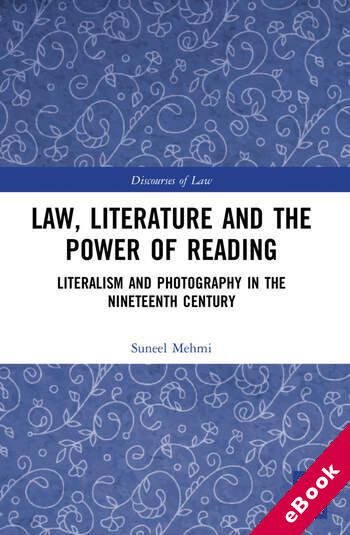
At the intersection of law, literature and history, this book interrogates how a dominant contemporary idea of law emerged out of specific ideas of reading in the nineteenth century. Reading shapes our identities. How we read shapes who we are. Reading also shapes our conceptions of what the law is, because the law is also a practice of reading. Focusing on the works of key Victorian writers closely associated with legal practice, this book addresses the way in which the identity of the reader of law has been modelled on the identity of the political elite. At the same time, it shows how other readers of law have been marginalised. The book thus shows how a construction of the law has emerged from the ordering of a power that discriminates between different readers and readings. More specifically, and in response to the emerging media of photography – and, with it, potentially subversive ideas of exposure and visibility – the book shows that there have been dominant, hidden and unrecognised guides to legal reading and to legal thought. And in making these visible, the book also aims to make them contestable. This secret history of law will appeal to legal historians, legal theorists, those working at the intersection of law and literature and others with interests in law and the visual.