
The eBooks we sell are sold as a single-user licence and are intended for the end user only.
The sale of some eBooks are restricted to certain countries. To alert you to such restrictions, please select the country of the billing address of your credit or debit card you wish to use for payment.
For further information see https://www.wildy.com/ebook-formats
Once the order is confirmed an e-mail will be sent to you to allow you to download the eBook. For UK purchases this will be automatic. For purchases outside the UK a member of staff will need to confirm the sale. (Staff are available to do this during normal business hours, Mon-Fri 8:30-17:00 UK time)
All eBooks are supplied firm sale and cannot be returned. If you believe there is a fault with your eBook then contact us on ebooks@wildy.com and we will help in resolving the issue. This does not affect your statutory rights.
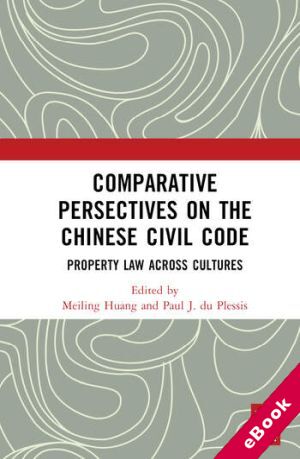
This book provides a comparative analysis of Chinese property law as depicted in the newly enacted Chinese Civil Code.
The Chinese Civil Code, the first civil code in the history of the People’s Republic China, was enacted as law in May 2020. Reflecting the growing interest in this code and its provisions to scholars of codification and of comparative private law, it has already been translated into English, German, and Italian. Chinese property law has both local and global features, and this comparative study offers a channel through which to understand Chinese property law, by highlighting both its similarities and differences from other systems of property. Broadly speaking, the book brings together two approaches. The first comprises a comprehensive discussion of aspects of Chinese property law, such as ownership, property rights, and secured transactions. The second consists in perspectives from other jurisdictions, and provide an assessment of Chinese property law based on other property systems. Containing contributions by both distinguished as well as young scholars, who are experienced in comparative property law research, the book offers a unique insight into the Chinese Civil Code and, through it, how extra-civilian elements are embodied in a fundamentally civilian legal system.
This book will appeal to scholars and students of property law, comparative law, and others with specific interests in law and politics in China.










