The eBooks we sell are sold as a single-user licence and are intended for the end user only.
The sale of some eBooks are restricted to certain countries. To alert you to such restrictions, please select the country of the billing address of your credit or debit card you wish to use for payment.
For further information see https://www.wildy.com/ebook-formats
Once the order is confirmed an e-mail will be sent to you to allow you to download the eBook. For UK purchases this will be automatic. For purchases outside the UK a member of staff will need to confirm the sale. (Staff are available to do this during normal business hours, Mon-Fri 8:30-17:00 UK time)
All eBooks are supplied firm sale and cannot be returned. If you believe there is a fault with your eBook then contact us on ebooks@wildy.com and we will help in resolving the issue. This does not affect your statutory rights.
Due to a technical issue some ebooks are not available to order.
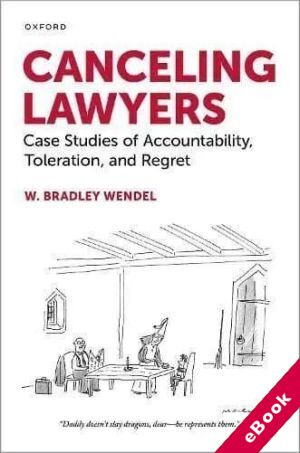
Lawyers take pride in a professional tradition of representing unpopular clients, understanding it as a contribution to the rule of law and the practice of toleration in a polarized society. This does not mean that lawyers are fully insulated from criticism for the clients they represent. The seemingly intractable debate over accountability for representing nasty clients is in part the result of a deep, structural tension between the institutions and procedures of the legal system, and the underlying issues and controversies about which people disagree. We also care about the attitudes and motives of lawyers, which play an important role in evaluating the actions of others.
Much of the frustration experienced by lawyers who are criticized for representing unpopular clients arises from what lawyers see as the public's inability to understand the rule of law and the function of the legal system in resolving conflicts over rights and justice. Using a series of case studies, this book explores the possibility that both lawyers and their critics are right. There is genuine value in a system of formal law that aims at settling social disagreement, but that is not the whole story. Public criticism of lawyers may reflect the sense that the legal system has fallen short of ideals of fairness and inclusiveness.
Many of the lawyer shaming or "canceling" episodes discussed in this book arise out of the representation of clients in matters involving issues where it appears that the official process of establishing and interpreting formal law has been captured by powerful interests. Accepting a certain amount of public criticism is necessary to avoid a dangerous isolation of the legal profession from accountability to the broader political community, or from the humanity of lawyers being submerged by their professional role.