The eBooks we sell are sold as a single-user licence and are intended for the end user only.
The sale of some eBooks are restricted to certain countries. To alert you to such restrictions, please select the country of the billing address of your credit or debit card you wish to use for payment.
For further information see https://www.wildy.com/ebook-formats
Once the order is confirmed an e-mail will be sent to you to allow you to download the eBook. For UK purchases this will be automatic. For purchases outside the UK a member of staff will need to confirm the sale. (Staff are available to do this during normal business hours, Mon-Fri 8:30-17:00 UK time)
All eBooks are supplied firm sale and cannot be returned. If you believe there is a fault with your eBook then contact us on ebooks@wildy.com and we will help in resolving the issue. This does not affect your statutory rights.
Due to a technical issue some ebooks are not available to order.
NB. This is a revised edition of Handbook of Blockchain Law: A Guide to Understanding and Resolving the Legal Challenges of Blockchain Technology by Matthias Artzt & Thomas Richter.
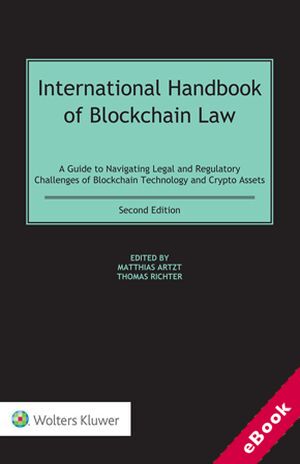
International Handbook of Blockchain Law, currently in its second edition, is a handbook comprising new chapters and topics but still following the systematic and structured approach of the first edition. Blockchain’s significant advances since 2020 – including many new use cases – have necessitated a comprehensive revision of the first edition of this matchless resource.
What’s in this book:
Each contributor – all of them practitioners experienced with blockchain projects within their respective areas of expertise and specific jurisdictions – elucidates the implications of blockchain technology and related legal issues under such headings as the following:
The foundational chapter on the technical aspects of blockchain technology has been meticulously expanded to elucidate the proof of stake consensus mechanism alongside fresh insights into the ERC-721 Token Standard for non-fungible tokens, decentralized exchanges, staking, stablecoins, and central bank digital currencies.
How this will help you:
As blockchain law cements itself as a distinct legal field, this new edition is invaluable for legal practitioners, in-house lawyers, IT professionals, consultancy firms, blockchain associations, and legal scholars. At a depth that allows non-IT experts to understand the groundwork for legal assessments, the handbook provides those charting the dynamic waters of this field of law with a compass, ensuring they are well-equipped to tackle the legal issues raised by the usage of blockchain technology.