The eBooks we sell are sold as a single-user licence and are intended for the end user only.
The sale of some eBooks are restricted to certain countries. To alert you to such restrictions, please select the country of the billing address of your credit or debit card you wish to use for payment.
For further information see https://www.wildy.com/ebook-formats
Once the order is confirmed an e-mail will be sent to you to allow you to download the eBook. For UK purchases this will be automatic. For purchases outside the UK a member of staff will need to confirm the sale. (Staff are available to do this during normal business hours, Mon-Fri 8:30-17:00 UK time)
All eBooks are supplied firm sale and cannot be returned. If you believe there is a fault with your eBook then contact us on ebooks@wildy.com and we will help in resolving the issue. This does not affect your statutory rights.
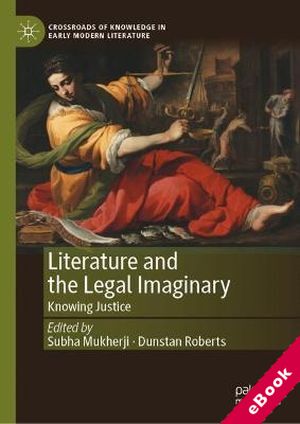
Tuning into the collective understanding of law as lived experience, Literature and the Legal Imaginary: Knowing Justice is a timely and distinctive intervention in the field of law and literature. It seeks to understand and inhabit the intersection between judicial procedure, legal thinking and imaginative practice, where epistemic processes that elude the formal discourses of law and legal history are generated and brought into view.
But the law in early modern England - the focus of this book though not its horizon - was also an imaginative resource and a repository of structures of feeling. These are functions uniquely grasped through literary mediation because literature shares the representational modes and structures of law but not its methods or ends. Bringing together established and younger scholars from literary studies, legal history, theology and law, and employing a variety of approaches, this collection of essays eschews flat description in favour of layered analysis, cognisant of the plurality of concept, practice and representation. In using a literary lens, it treats apparent binaries or distinct registers as interlinked constituents of an ecology, and navigates the gap between abstract jurisprudence and the affective, composite, social event of justice or judgment. Its perception of 'literature', likewise, is capacious: including imaginative method, literary strategies used by law and its cognate disciplines, and hermeneutic and critical methods that are traditionally regarded as literary. Its notion of epistemology, meanwhile, encompasses not simply the condition of judicial knowledge but also its process, psychology and ethics: it attempts to know justice at the same time as it attends to what justice knows, fails to know, or resists knowing.